

Public thesis defense Sophie De Raedemacker - IMMC
sst |
Design and characterisation of a new healable high-strength aluminium alloy manufactured by Powder Bed Fusion – Laser Beam
Tuesday September 8th, 2026 - 4:15pm - Auditorium BARB91 - Place Sainte-Barbe, 1 - 1348 Louvain-la-Neuve
Additive manufacturing enables the fabrication of lightweight aluminium components with complex geometries but often introduces microvoids and microcracks that degrade mechanical properties. Healing ability of high-strength Al alloys offers a promising strategy to mitigate these defects.
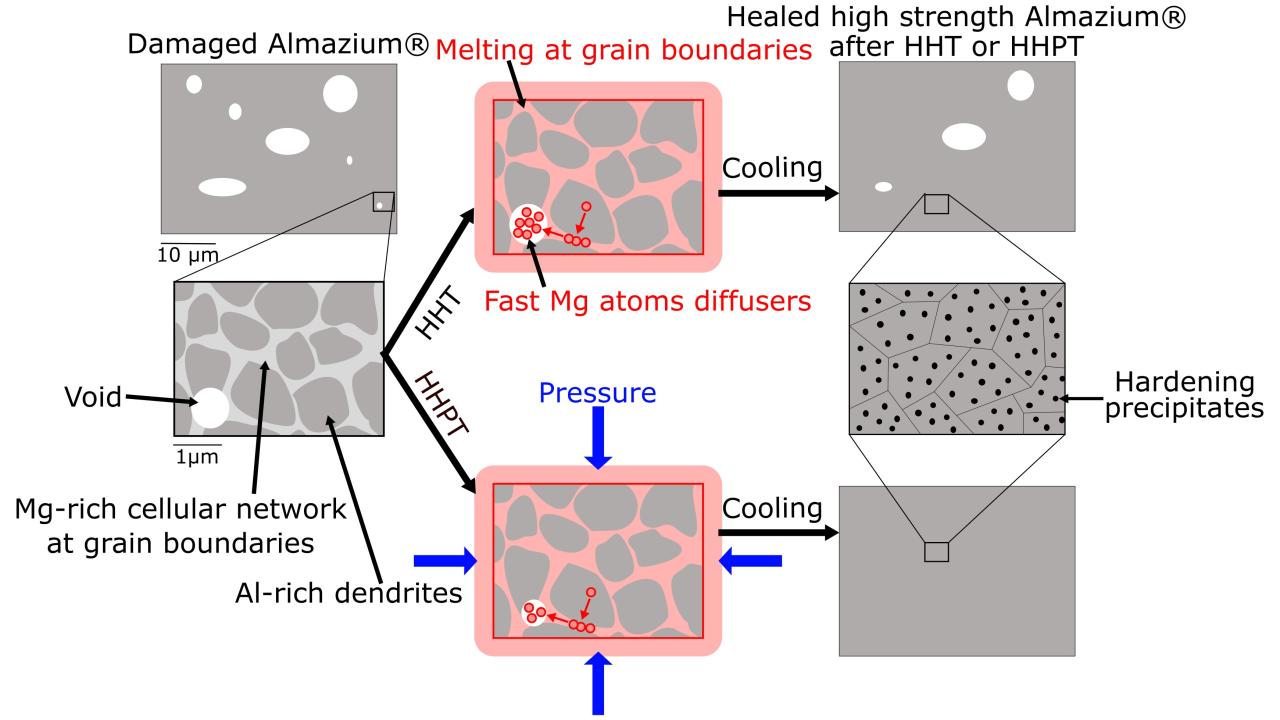
A proof of concept was first established using mechanically mixed powder, producing an AlMg6.7Zr alloy. Synchrotron X-ray nano-holo-tomography (nano-CT) demonstrated that a Healing Heat Treatment (HHT) (540 °C for 30 min) achieved complete closure of 65% of submicrometric voids, healing voids up to 3.7 μm. The healing mechanism was primarily driven by Mg diffusion. Combining heat and pressure treatments drastically enhanced healing efficiency, enabling complete closure of voids at least up to 100 μm.
Building upon these results, pre-alloyed powder was used, leading to the AlMg9.3Zr alloy. Repeated tensile loading and thermal treatment cycles (540 °C, 20 min) were monitored by in-situ synchrotron X-ray nano-CT. Voids up to 1 μm were healed and remained closed during subsequent tensile loading..
Finally, the PBF-LB/M processing parameters were optimised using pre-alloyed powder, resulting in the AlMg10Zr alloy. The increased Mg content promoted β-Al3Mg2 precipitation, which further coarsened during HHT and reduced ductility from 16% in the AB state to 4% after HHT. This AlMg10Zr alloy also exhibited a fatigue life comparable to that of high-strength Scalmalloy®.
Overall, Almazium® demonstrates that a high-strength aluminium alloy can exhibit intrinsic, repeatable healing ability when processed by PBF-LB/M. These results open new pathways for the design of healable aluminium alloys and provide a foundation for developing next-generation lightweight structural materials with extended service life.
Jury members
Prof. Aude Simar (UCLouvain), Supervisor
Prof. Hadrien Rattez (UCLouvain), Chairperson
Prof. Hosni Idrissi (UClouvain), Secretary
Dr. Florent Hannard (Chercheur indépendant, Belgique)
Dr. Julie Gheysen (EPFL, Switzerland)
Dr. David Tingaud (Université Sorbonne Paris Nord, France)
Prof. Teresa Pérez-Prado (IMDEA Materials Institute, Spain)