

Chaire Francqui 2027
fasb | Bruxelles Woluwe
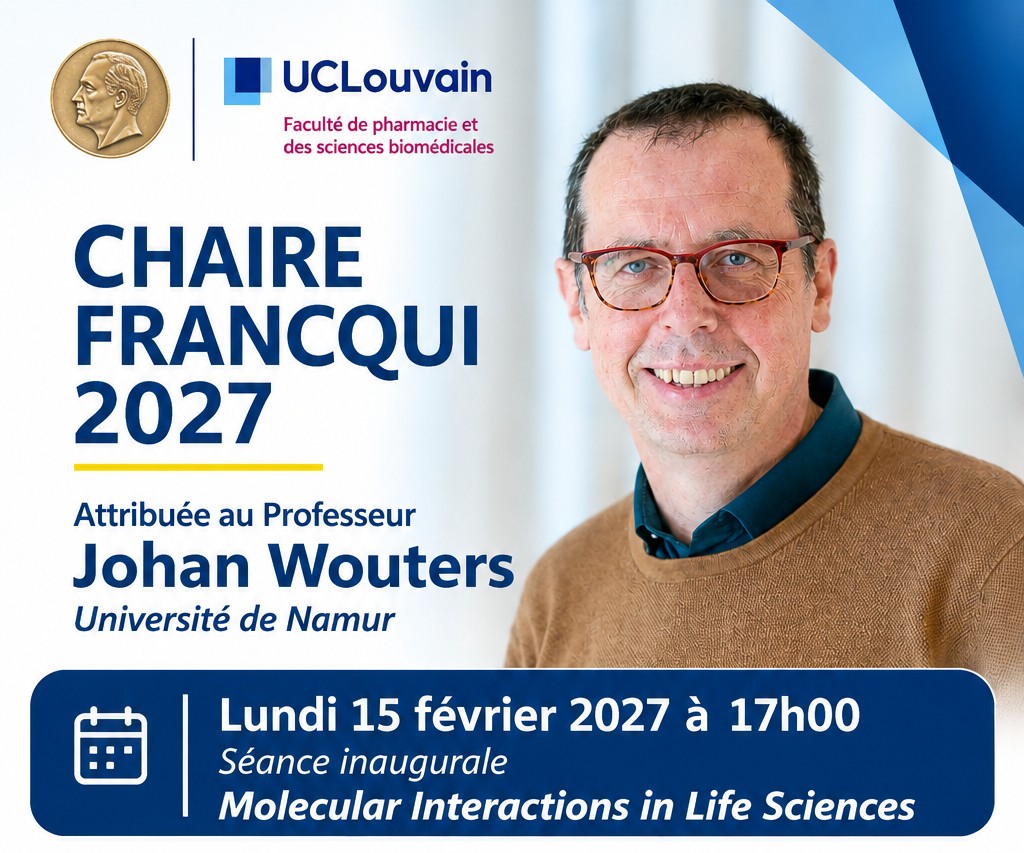
Professeur Johan Wouters
After a Ph.D. financed by the FNRS (Aspirant) presented in 1995 in the field of Structural Chemistry at the Facultés Notre Dame de la Paix (Belgium), J.Wouters made two postdocs within international groups in crystallography (G.Sheldrick, Goettingen (Germany) and O.Dideberg Grenoble (France)). From 2001-2004 he became responsible of the protein crystallography group at the Wiame Research Institute, Brussels (Belgium). In 2004, he was appointed to an assistant professorship at the University of Namur where he is now full professor.
Since the beginning of his scientific career at UNamur, J.Wouters has developed a research group dedicated to Structural Biological Chemistry. He has supervised 26 PhD thesis, more than 60 Master thesis, and published over 360 publications in peer reviewed scientific journals.
He is an active member of the national committee of Crystallography and of the national committee of Chemistry (Belgian Academy of Sciences), and member of the Belgian Royal Society of Chemistry, from which he received the Triennal Prize in 2008.
He is responsible for the crystallographic technological platform at UNamur and has developed a dense network of (inter)national scientific collaborations.
Programme :
Lundi 15 février 2027 à 17h00 (Auditoire Lacroix) : Séance inaugurale
Molecular Interactions in Life SciencesThe main goal of this lecture is to show how a deep understanding of the molecular principles underlying molecular interactions allows a better understanding of processes essential in life sciences and provides a means to rationally interfere with those events. Structural characterization of the biological systems is central and can rely on complementary experimental and modelling approaches.
Selected examples taken from studies from the group will be given to illustrate the central role of molecular interactions in life sciences, governing key processes such as sensing, recognition and communication.
Protein-protein interactions and their role in regulation of central biological mechanisms will also be addressed through recent structures determined by combined molecular simulations (including AI derived approaches) and experimental biophysical approaches (crystallography and cryoEM). A focus on homomeric interactions will be given to illustrate the use of oligomeric molecular cages or lead to the concept of morpheins.
Lundi 22 février 2027, de 10h45 à 12h45 (Auditoire 51B) : Lecture 1
Toward a Better Understanding of Molecular Interactions: A Non-Mathematical ApproachThrough an historical overview of the foundations of basic forces the audience will feel how crucial interactions are to govern molecular recognition and assembly in biological systems.
Lundi 8 mars 2027, de 10h45 à 12h45 (Auditoire 51B) : Lecture 2
Crystallization as a Molecular Assembly Game: Pharmaceutical Salts and CocrystalsPharmaceutical polymorphism and the issues related to crystallization of selected solid forms through crystal engineering will be exemplified to illustrate the role of molecular interactions when dealing with biological active compounds.
Lundi 15 mars 2027, de 10h45 à 12h45 (Auditoire 51B) : Lecture 3
Molecular Recognition in Life Sciences: Docking Simulations, Biophysical Methods, and BeyondMolecular interactions in life sciences will be further illustrated through examples of molecular docking of ligands into macromolecules (enzymes, receptors, DNA), key processes to sensing, recognition and communication. Structural characterizations will rely on molecular simulations (including AI derived approaches) and experimental biophysical approaches (crystallography and cryoEM).
Lundi 22 mars 2027, de 10h45 à 12h45 (Auditoire 51B) : Lecture 4
Protein-Protein Interactions: Checkpoints for Biological Response and Levers for Molecular InterventionProtein-protein interactions and their role in regulation of central biological mechanisms will be addressed. A focus on homomeric interactions will be given to illustrate the use of oligomeric molecular cages or lead to the concept of morpheins.
Inscriptions : https://forms.cloud.microsoft/e/xPeZGawEUr