PTech

pftplus |

Whether you are looking for state-of-the-art equipment, wishing to promote outstanding research infrastructure, or seeking to optimize the management of your equipment resources, P-TECH is the solution for you.

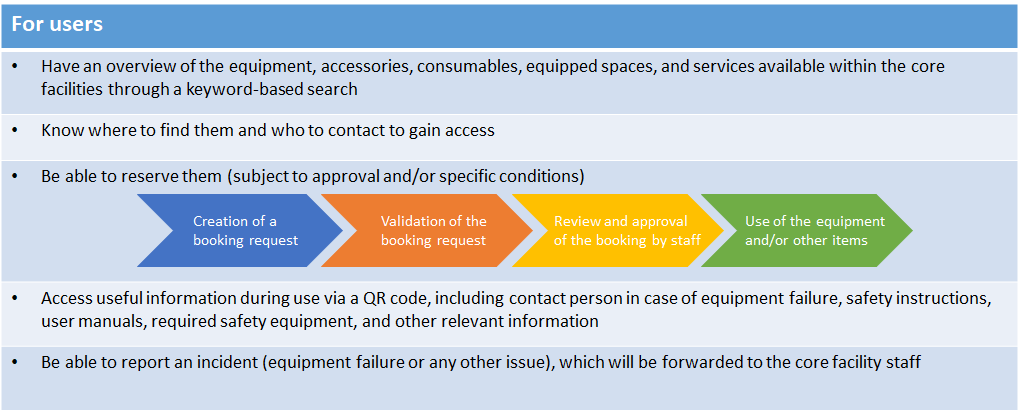
Quickly find the equipment you need

When planning your research projects, you may often need to acquire new scientific equipment. Yet funding bodies do not always support the purchase of equipment that already exists within the same institution.
How can you determine whether the equipment you need is already available at UCLouvain?

Another common scenario: during a research project, a master’s thesis, a PhD, or postdoctoral research, you may need to perform an urgent experiment when your equipment is unavailable or has broken down.
How can you quickly find an alternative solution and get in touch with the right expert?

If the equipment you need is located within your institute, things will be fairly straightforward.
But when it is hosted elsewhere in the university, having a centralized tool becomes a real advantage.

Meeting funders' requirements

Many funding bodies now require detailed monitoring of the use of funded equipment, including utilization rates, users, and associated projects.
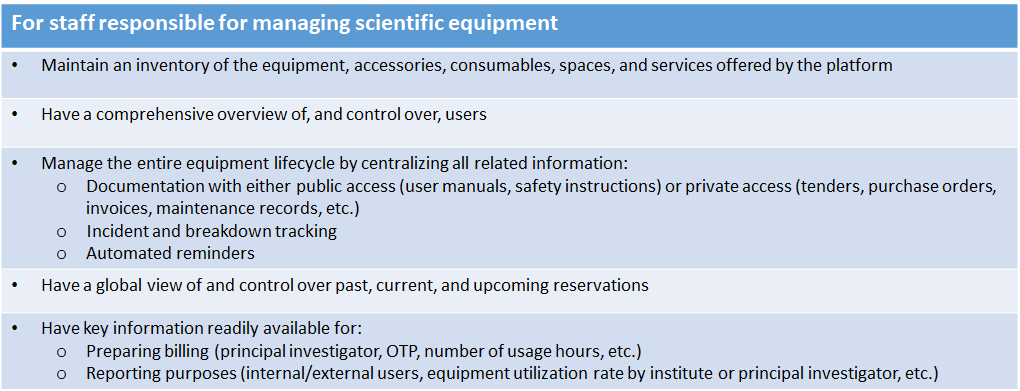
P-Tech simplifies this process by automatically collecting and extracting the data needed for reporting.

Highlighting exceptional equipment

Does your team have unique facilities or equipment?
P-Tech gives you the opportunity to increase their visibility, both within the university community and among external stakeholders, including companies that may be interested in using them.

Efficiently manage your equipment portfolio

For platform and equipment portfolio managers, P-Tech provides a real-time overview of who is using which equipment, when, and for what purpose. The tool enables them to centralize all information related to an equipment’s lifecycle and usage, while also offering the ability to extract a wide range of data for billing preparation and reporting purposes.

A valuable tool for optimizing the management, utilization, and promotion of scientific resources!


Institute, research pole, platform, or research group
If you would like to include some of your equipment in P-TECH to facilitate its management or increase its visibility, contact the team responsible for developing the tool!

contact-ptech@uclouvain.be

Thanks to your contributions, this inventory will continue to grow over time for the benefit of the entire UCLouvain community.
A tutorial is available to help users become familiar with the main features of the platform in approximately 45 minutes.

The tutorial consists of a PDF guide that walks users through the platform step by step.

It can be accessed via the following link: https://qa.app.uclouvain.be/PTech/PTechHome

  1. Click "Find a platform", then search for "Tuto" in the "Search" field.
  2. On the homepage of "TUTORIAL - Getting Started with PTech" (a fictitious woodworking platform), click "Start tutorial" and wait a few seconds for the file to download.
    Open the downloaded PDF and follow the instructions provided.
  3. You may enter any data you wish during the tutorial. All data entered will be automatically deleted when you log out.

How was PTech created?

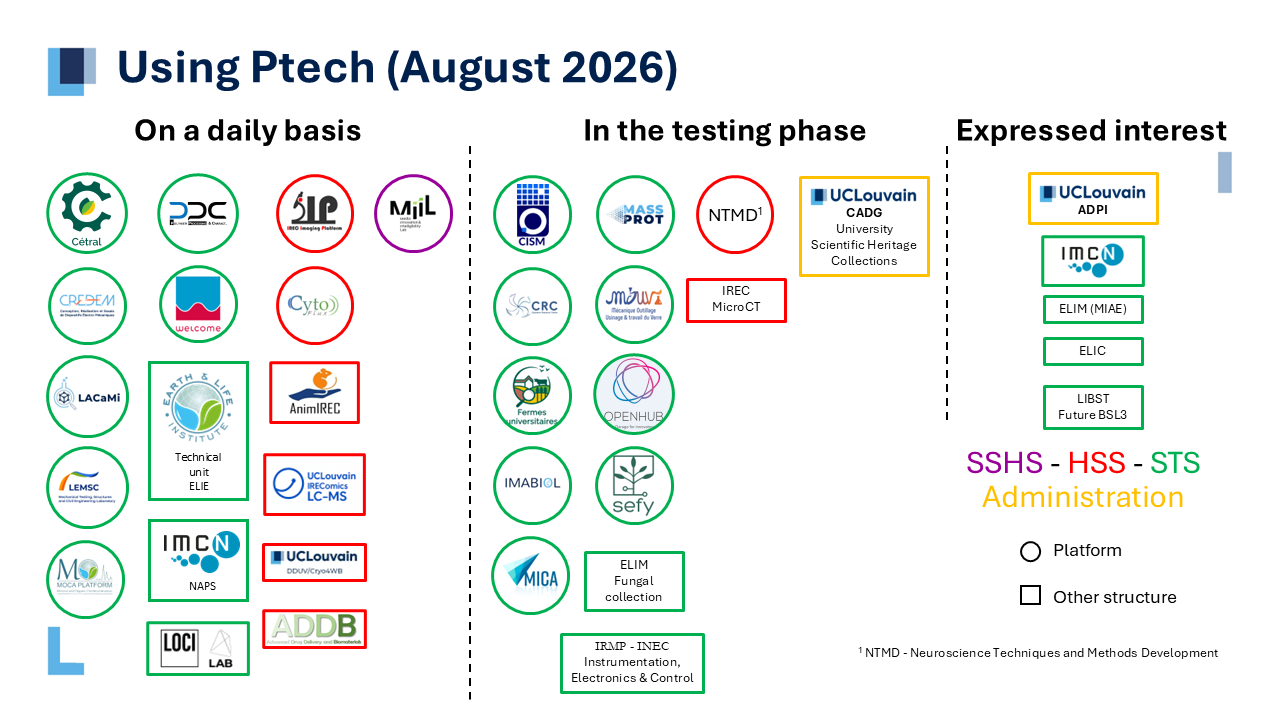
PTech is born from the need expressed by the coordinators of the STS platforms for a shared tool to manage their equipment inventories and facilities.

Given the diversity of the platforms and their operating models, it quickly became clear that the best approach was to develop a common core with a wide range of optional features that could be activated according to each platform's specific needs.

The decision was also made to pursue an in-house development, allowing the University to retain full control over the tool's history and future developments, while avoiding the administrative complexity associated with public procurement procedures.

PTech was developed using OutSystems, a low-code application for which UCLouvain holds a license. The project was carried out in consultation with SGSI, with one notable feature: Rémi Dekimpe, a research logistics officer within ICTEAM, was granted administrator rights and therefore became the architect of PTech in 2024. Since then, he has continued to maintain and develop the tool, dedicating approximately 10% of his time to the project.

Given the growing enthusiasm for the tool, he will be joined from the beginning of the 2026 academic year by Pierre-Yves Barriat (ELI/ELIC), who will also dedicate around 10% of his time to PTech.

Why make it an institution-wide tool?

Managing scientific equipment is not a concern limited to platforms alone. Other entities, including institutes, poles, centres, and research groups, quickly expressed an interest in using the tool.

With a view to sharing resources and improving efficiency, the Science and Technology Sector (SST) therefore proposed extending PTech to the University's two other sectors.

In practice, many members of the University community have experienced how difficult it can be to determine whether a particular piece of scientific equipment exists at UCLouvain and whom to contact about it. Without a centralized and accessible inventory, finding information often feels like looking for a needle in a haystack.

PTech addresses this challenge by enabling a comprehensive search across all equipment, accessories, consumables, equipped facilities, and services recorded by participating entities.

The idea then emerged of using PTech as a central inventory of the main scientific equipment available at UCLouvain and making this information accessible to academic, scientific, technical, and administrative staff.

This is how the project evolved from a sector-based initiative into an institution-wide undertaking.

What's next?

PTech, its features, and its potential were presented to the Presidents of the Institutes of the Science and Technology Sector (SST) and the Health Sciences Sector (SSS) in November 2025, and to those of the Humanities and Social Sciences Sector (SSH) in March 2026.

In July 2026, the initiative received the support of the Vice-Rector for research, Professor Agnès Guiderdoni, to extend its deployment across the University and thereby contribute to the development of a comprehensive and reliable inventory.