

AGENTS OF CHANGE. (Serbian) Students and Universities in Struggle for Academic Freedom, University Autonomy and Democracy
With the support of the Rector of Université catholique de Louvain (UCLouvain), Professor Françoise Smets, and of CircleU., the Alliance of European Universities, and in coordination with Professor Isabelle Aujoulat, Vice-Rector for Equity, Diversity and Inclusion, and Professor Hervé Jeanmart, Pro-Rector for International Affairs, the Centre for Theatre Studies (Centre d’études théâtrales, CET) and UCLouvain are pleased to invite you to Agents of Change: (Serbian) Students and Universities in Struggle for Academic Freedom, University Autonomy and Democracy, an international workshop and set of panels taking place on 12–13 March 2026 inLouvain-la-Neuve.
The event brings together students and professors from Serbia and Belgium, alongside invited institutional and cultural actors, to discuss the Serbian student-led movement since November 2024 and the broader question of how universities can remain autonomous spaces of critical thought and democratic responsibility, especially under political, legal, and economic pressures that reshape governance, working conditions, and the public legitimacy of higher education.
Participants include members of the University of Belgrade, our partner in Circle U.
Organisational Committee
Jonathan Châtel, Centre for Theatre Studies – institutional coordinator, co-organiser (INCAL, UCLouvain)
Goran Petrović Lotina – programme coordinator, co-organiser (UCLouvain; Sciences Po Paris)
Registration Link
The registration is free for everyone wishing to attend the conference.
Centre for Theatre Studies
Founded in 1968, the Centre for Theatre Studies was one of the pioneers in introducing theatre studies to universities. This intrinsically interdisciplinary field lies at the intersection of aesthetics, ethics, and sociopolitics. Its aim is to analyse theatre in all its complexity, combining theory and practice, art and critical thinking.
The Centre for Theatre Studies’ Master’s programme brings together internationally renowned professors and is aimed at students (of all ages) who wish to begin or pursue a career in the cultural and artistic fields—a goal achieved by more than 90% of them.
Because theatre is an art of the city—an art of engagement—the Centre has always sought to remain attentive to societal upheavals. It seeks to echo, at its own level, the crises and questions that our democracies are facing.
The initiative we are launching, in relation to the situation in Serbia, is part of this ongoing commitment. It responds to a twofold need: on the one hand, to raise awareness of the threats to universities, academic freedom, and freedom of thought—threats that are symptomatic of a broader movement of reactionary regression; on the other hand, to recall the founding role of the Faculty of Dramatic Arts in Belgrade in the Serbian student-led movement, which reveals the political power of theatre and critical thinking.
Finally, this context reinforces our desire to draw attention to a little-known situation, largely ignored by the Belgian media and European authorities, for reasons that urgently need to be questioned.
Student-led Protests in Serbia
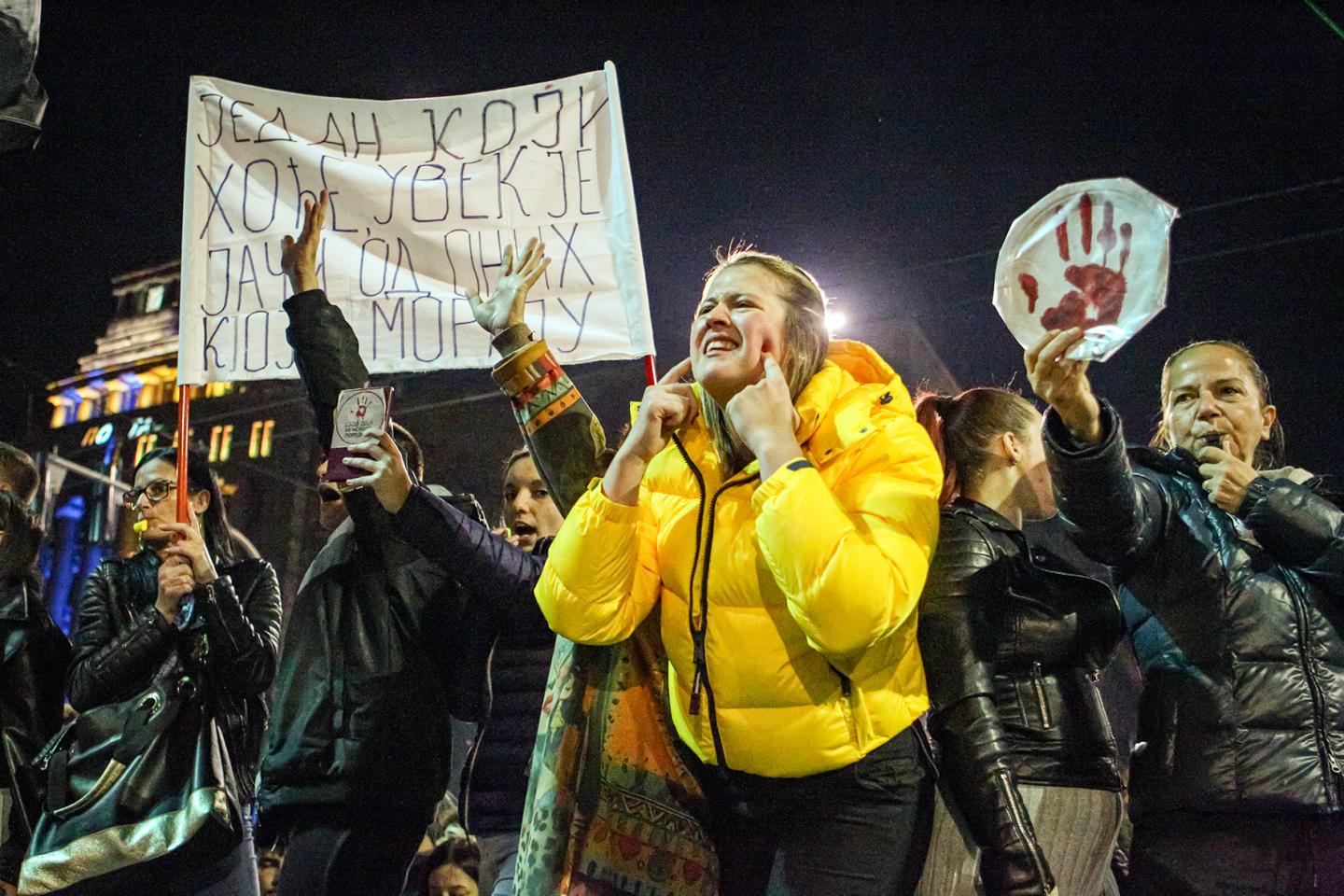
On 1 November 2024, a newly reconstructed concrete canopy at the Novi Sad railway station collapsed, killing sixteen people. The tragedy quickly became a symbol of institutional decay, corruption, and government negligence, igniting what has since grown into an unprecedented, student-led protest movement across Serbia. What began as daily silent moments of mourning at 11:52 a.m., the time of the collapse, soon evolved into a nationwide civic uprising uniting student, their professors, and citizens.
The students’ demands initially focused on justice for the victims but soon expanded to include the full disclosure of documentation related to the railway reconstruction and accountability for those responsible; the identification and punishment of individuals who attacked students and professors; the dismissal of charges against detained protesters; and a 20% increase in budget allocations for public universities.
The government’s response was marked by repression and violence, particularly targeting students. Peaceful demonstrations were repeatedly met with excessive force, resulting in injuries and the detention of numerous students. Professors who expressed solidarity with their students faced disciplinary actions and the suspension of salaries, while universities were subjected to economic coercion aimed at discouraging support for the protests. The use of sound cannons during the massive protest in Belgrade on 15 March 2025 was widely condemned by civil society and human rights organizations, as was the excessive police force used against peaceful protests in the following months.
Despite sustained pressure, the student-led movement remains active and increasingly organized, distinguished by creativity, resilience, and strong intergenerational solidarity. By mid-2025, students began preparing their own independent electoral list, calling for early elections and advocating for a democratic political alternative that embraces Serbia’s cultural, linguistic, ethnic, and religious diversity. On 1 November 2025, a large commemorative gathering took place in Novi Sad, bringing together students from all state universities across Serbia. The students are currently developing a detailed political programme.
In light of these developments, the Centre for Theatre Studies organises an international workshop and set of panels entitled Agents of Change: (Serbian) Students and Universities in Struggle for Academic Freedom, University Autonomy and Democracy. The seminar will bring together students and professors from Serbia and Belgium, as well as representatives of European institutions, to reflect on the Serbian student-led movement, the role of universities in defending democratic values, and the significance and power of education to inspire political and social transformation. Beyond the Serbian context, these events raise crucial questions for the global academic community: How can universities remain autonomous spaces of critical thought? How can students, as agents of change, safeguard democratic principles in times of right-wing and authoritarian resurgence across Europe and beyond? The seminar aims to open a transnational dialogue on these urgent issues, reaffirming the shared responsibility of higher education institutions in protecting freedom, knowledge, and democracy.
Biographies
Programme
DAY 1 (March 12)
WORKSHOP (4-6 hours)
Address: Salle polyvalente, Learning Center Christine de Pizan, A.006.10
Collège Érasme, Place Cardinal Mercier 31, Louvain-la-Neuve.
Format: Workshop. Closed to the audience.
Participants: students from Serbia and a number of UCLouvain students.
Hosted by: KAP Justice Internationale UCLouvain.
DAY 2 (March 13)
PANELS (09.45h-16.30h)
Address: Salle polyvalente, Learning Center Christine de Pizan, A.006.10
Collège Érasme, Place Cardinal Mercier 31, Louvain-la-Neuve.
09.45h Registration: Coffee / tea
10h – Welcoming words
Opening remarks
- Prof. Françoise Smets, Rector (Université catholique de Louvain – UCLouvain).
Welcome
- Jonathan Châtel, PhD (INCAL, UCLouvain)
- Goran Petrović Lotina, PhD (UCLouvain, Sciences Po Paris, Ca’ Foscari University of Venice)
10.15h Film Screening, A documentary on the student protests in Serbia.
10h30
PANEL I: Students’ Testimonies and Strategies (75 min)
Participating students
- Emina Spahić (University of Novi Pazar)
- Tijana Tepavac (University of Novi Sad)
- Filip Ubović (University of Belgrade)
Moderation: Students, KAP Justice Internationale (UCLouvain).
11.45h Break (15min): Coffee / tea
12.00h
PANEL II: Professors’ Perspectives: University Autonomy under Threat (75 min)
Participants:
- Prof. Vanja Bajović, Faculty of Law, University of Belgrade
- Prof. Stevan Filipović, Faculty of Dramatic Arts, University of Arts in Belgrade
- Prof. Radina Vučetić, Faculty of Philosophy, University of Belgrade
- Intervention: Prof. Stefan Janković (Institute for Sociological Research, University of Belgrade)
Moderation: Jonathan Châtel (UCLouvain)
13.15h Break (1.15 hour): Informal mingling, coffee, lunch.
14.30h
PANEL III: Debate: From Serbia’s Student Movement to Europe’s Public Sphere (105 min)
Participants:
- Student 1 (Serbia)
- Student 2 (Belgium)
- Prof. Vanja Bajović (Faculty of Law, University of Belgrade)
- Gordan Bosanac, Member of the European parliament, Greens/EFA group (Možemo!, Croatia)
- Marijana Cvetković (Cultural Producer, Curator, Pedagogue)
- Stefan Zotti (Deputy Head of Unit – Higher Education; EC: DG EAC)
- Prof. Geoffrey Pleyers (FNRS Research Director at CriDIS/Iacchos, Université catholique de Louvain. President of the International Sociological Association)
- Intervention: Miloš Lolić (Theatre Director)
Moderator: Goran Petrović Lotina (UClouvain, Sciences Po Paris, Ca’ Foscari UVenice)
16.15 Closing Session (15 min)
16.30 The END
19.00 Dinner



Photo copyright: Relja Jarkovački, Soutien à Dijana Hrka, 2025.
-
Jeudi, 12 mars 2026, 16h00Vendredi, 13 mars 2026, 16h30
-
Contactjonathan.chatel@uclouvain.beBelgique