



News


Workshop : Advertising and Self-Promotion through Images in the Digital Era: Impacts on Consumers
Overview
The ETIC (EffecTs of digital Images on Consumers) project focuses on the negative influences of digital advertising and promotional images on people. lndividuals are analyzed in a dual perspective; as consumers of images on screens, as well as disseminators of images on social media. The aim is to study the consequences of marketing strategies (the attractive and distracting power of images, personification, repeated exposure) on cognitive costs and psychological defense mechanisms, problematic behaviors, negative emotions, and other psychological disorders. The originality of the project lies in the analysis of the similarities and differences in strategies between marketing professionals, and internet users who engage in self-promotion on social media. The purpose of the ETIC project is to define recommendations for reducing these negative effects, in particular through awareness-raising initiatives. This conference addresses two aspects: the impact on consumers of multiple exposure to advertising images, and the impact on consumers of exposure to self-promotional images posted on social media.
Registration
Registration for the event can be completed online, on the project website : https://etic.hypotheses.org/2628 There is a registration fee for this workshop:
- €50 for those who have submitted papers, and PhD students.
- €80 for academics, and professionals.
Registration deadline: September 11, 2026.
PhD Grants
As part of this research day, we try to provide support to PhD students who may encounter funding difficulties at their institutions, but wish to take part in the event. As a result, we offer two €500 PhD grants for their travel and accommodation. These funds are intended to encourage doctoral student participation, maintain a dynamic research environment, and promote academic exchange. You may apply to this grant at the following email address : etic@listes.univ-angers.fr. Registration deadline: May 31, 2026.

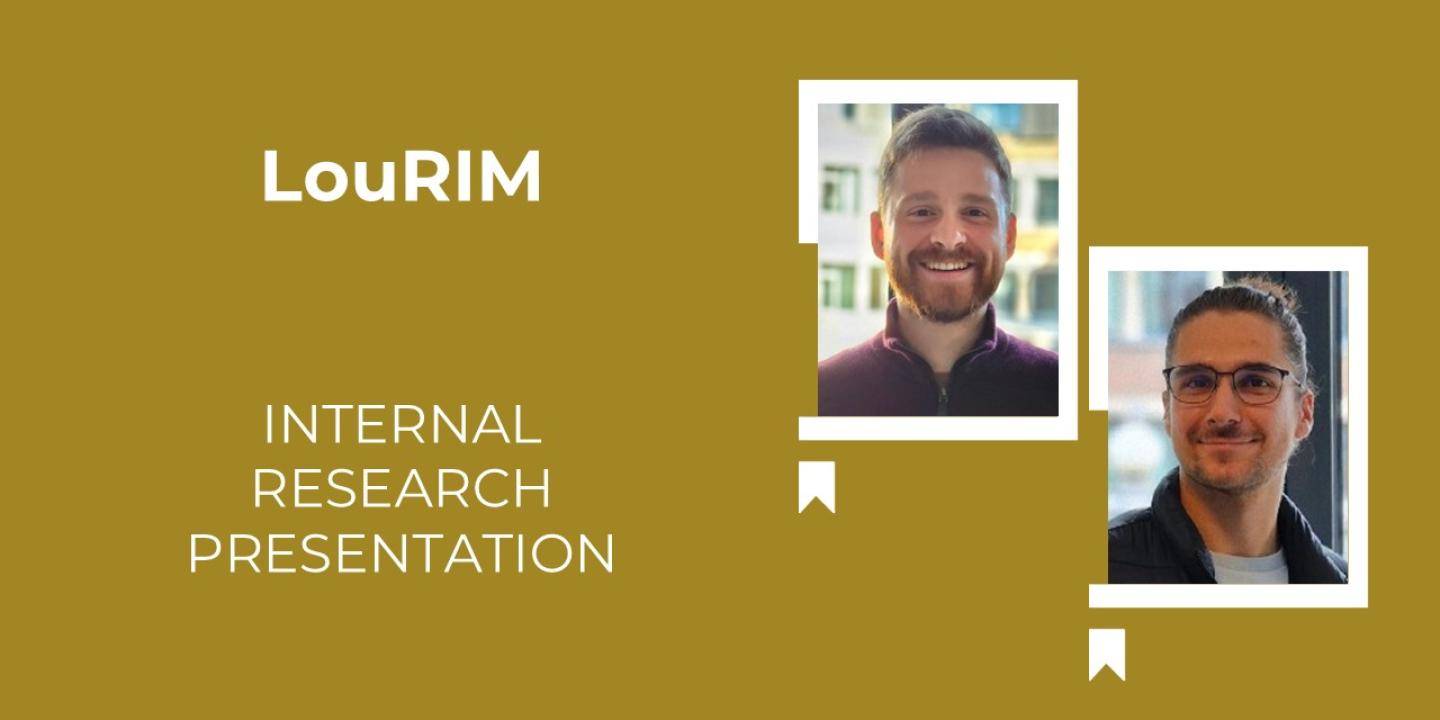
Informal research seminar by Valentine Brognion and Florian Dulaunoy
Grasping the In-Between: A Dimensional Typology of Interstitial Episodes
Valentine Brognion, Louvain Research Institute in Management and Organizations
Guilhem Bascle, Louvain Research Institute in Management and Organizations
Summary
This conceptual paper explores the micro-spatial configurations of interstitial episodes and their transformative potential at the individual level. Interstitial space is characterized by a place and time of interaction where individuals from different domains interact occasionally and informally around shared activities to which they dedicate a limited amount of time (Furnari, 2014, p. 439). We consider interstitial space at the scale of the interstitial episode, that is, a bounded exposure (time) generating recurring and differentiated interaction patterns specific to a meeting venue (place). Our analysis thus focuses on the micro-spatial description of how exposure to interstitial spaces supports cognitive and relational shifts at the individual level. We broaden the scope of interstitial spaces by developing a dimensional typology that presents systematic variations in the ability of interstitial episodes to cultivate change at the individual level.
Keywords: interstitial space, interstitial episode, spatial affordance, third places, change
Access on Teams

LouRIM seminar series on AI #2: Responsible AI
This second session of the LouRIM Seminar Series on AI, entitled Responsible AI, follows the first session AI Tools for Research, which was met with great success. In this session, we will explore the challenges related to the responsible, critical, and thoughtful use of artificial intelligence in a research context.
During this 90-minute session, we will explore seven major pillars of AI-related risks. Each topic will be approached through a combination of theoretical explanations, real-world examples, interactive discussions, and, for some themes, games or participatory exercises.
Topics covered will include:
bias and discrimination,
reliability and hallucinations,
transparency and explainability,
privacy and personal data,
societal impacts,
overreliance on AI tools,
good practices for academic research.
The goal of this session is to provide participants with practical guidelines for using AI tools in a more informed and responsible way, while developing a critical understanding of their limitations and potential impacts. Please note that environmental aspects of artificial intelligence will not be covered during this session. This topic will be addressed in a future session of the series.
All resources related to the seminar series are available on the following GitHub repository: https://github.com/cvandekerckh/lourim-ai-seminar-series

Research seminar in Circular Economy
Research seminar by Julian Kirchherr from Utrecht University/Roskilde University/McKinsey & Company, invited by James Thewissen
More about Julian Kirchherr (from Utrecht University)
Research focus: Circular economy, Sustainability transitions
Dr. Julian Kirchherr is a researcher at the Copernicus Institute of Sustainable Development (CISD) at Utrecht University and Associate Partner at McKinsey & Company. He started his work at CISD as a tenure-track assistant professor in 2017. Julian holds a doctorate from the School of Geography and the Environment, University of Oxford.
Focus on sustainable transitions
Much of Julian's research investigates sustainability transitions and the role the private sector can play in these. Most of his current work investigates the circular economy concept as a vehicle for such transitions. For instance, he’s the Principle Investigator (PI) of the NWO-funded research project Transitioning Towards a Circular Economy: The Role of Circular Start-up Hubs. He also supervises several PhD projects on the circular economy.



Doctoral course : Designing and Managing Research Projects
Schedule
Date | Start | End | Location |
Wednesday September 16, 2026 | 10h45 | 12h15 | |
Wednesday September 23, 2026 | 09h45 | 12h45 | DOYEN 21 |
Wednesday September 30, 2026 | 09h45 | 12h45 | DOYEN 21 |
Wednesday October 07, 2026 | 09h45 | 12h45 | DOYEN 21 |
Wednesday October 14, 2026 | 09h45 | 12h45 | DOYEN 21 |
Wednesday October 21, 2026 | 09h45 | 12h45 | DOYEN 21 |
Thursday November 05, 2026 | 08h30 | 12h30 | DOYEN 21 |
Description
This course introduces students to the essential stages of the research project lifecycle, from problem identification to project execution. It emphasizes how to formulate clear research questions, define objectives and hypotheses, and anchor them within theoretical frameworks. Students will learn to design rigorous research protocols, select appropriate methodological approaches, and plan resources, timelines and milestones effectively. The course also covers project management tools - such as Gantt charts, risk assessment frameworks, and contingency planning, as well as good practices for collaboration, supervision and progress monitoring. By the end of the seminar, students will be able to prepare a structured research plan, design a research project aligned with academic standards, and present their proposal with confidence and clarity.
3 ECTS
Prof. Valérie SWAEN & Ingrid PONCIN
See the full course description here
CONTENT
This course has four main objectives:
Framing a Research Problem
Identifying gaps in the literature
Defining research objectives and hypotheses
Aligning research questions with theoretical frameworks
Positioning a research project within an existing body of knowledge
Structuring a Research Project
Designing a research protocol
Choosing qualitative, quantitative, or mixed methodologies
Constructing variables and defining data needs
Planning data collection and analysis strategies
Project Management Tools
Develop Gantt charts, milestones, and deliverables
Resource allocation and timeline planning
Risk assessment and contingency planning
Collaboration and supervision dynamics
Writing a doctoral admission file
Gather and produce all the required materials to complete a doctoral admission application or a doctoral scholarship submission
EVALUATION METHODS
Students are assessed on a continuous basis, including:
Group activities: reading, analyzing, presenting and discussing scientific articles and research projects;
Individual assignments: developing a robust research project and preparing a detailed research plan.
Oral presentation: pitching a doctoral research project.
Class participation.
By the end of this seminar, students will be able to:
Prepare a structured and coherent research plan.
Write a research project aligned with academic standards.
Pitch their doctoral research proposal effectively.
Important note: By submitting an assignment for evaluation, students affirm that (i) the work accurately reflects the verified facts—particularly when generative AI tools are used, which must be explicitly acknowledged—and (ii) all requirements, including those related to transparency and documentation, have been fully met.
Failure to respect these commitments, whether intentionally or through negligence, constitutes a violation of academic integrity and will be treated as academic misconduct

Doctoral course : Research ethics and open science
Exact Schedule unknown
Description
In recent years, the scientific community has confronted significant challenges that threaten its credibility and its contribution to society. The so-called reproducibility crisis has shown that a substantial share of published findings cannot be reliably replicated, raising concerns about the robustness of current research practices. At the same time, growing awareness of questionable research practices has highlighted the urgent need for stronger norms of integrity, transparency and responsible conduct.
This course engages with these challenges by examining the principles of research ethics and the transformative potential of open science. Openness and transparency are not abstract ideals; they are essential for rebuilding trust in scientific work and ensuring that research genuinely serves the public good. Participants will explore how to implement responsible data management, share research outputs openly, and navigate complex ethical dilemmas, particularly in a landscape increasingly shaped by artificial intelligence. By fostering integrity, accountability and critical reflection, this course prepares future researchers to lead with rigor, openness, and responsibility in a rapidly evolving scientific environment.
3 ECTS
See the full course description here
CONTENT
This course has two primary objectives:
To examine the fundamental principles of scientific integrity and research ethics, addressing key challenges, common pitfalls, and best practices for ensuring responsible and ethical research conduct.
To examine the core dimensions of Open Science – its rationale, benefits and limitations - and provide practical guidance on how researchers can meaningfully and effectively implement open science practices throughout the research lifecycle.
Content covered includes:
Foundations of research ethics and responsible conduct of research
Principles and norms of scientific integrity (e.g., honesty, transparency, accountability, rigor)
Open Science: concepts, societal value, and current policy landscape
Open Access to scientific publications: models, rights retention, and strategic choices
Open and FAIR data: principles, benefits, and challenges
Responsible research data management, including Data Management Plans
Preregistration and registered reports: purposes, platforms, and practical implementation
Ethical and methodological challenges in an era of AI‑assisted research
Tensions and trade‑offs between openness, privacy, intellectual property, and research ethics
EVALUATION METHODS
As part of this course, students are assessed on a continuous basis. The evaluation includes:
(i) Group activities such as reading, analyzing, presenting and discussing scientific articles related to research ethics and open science;
(ii) Individual assignments, including the development of a robust Data Management Plan (DMP) for their master thesis or doctoral project (applying FAIR principles), the drafting of a preregistration, and/or the creation and presentation of an Open science integration plan;
(iii) active class participation.
Important note: By submitting an assignment for evaluation, students affirm that (i) the submitted work accurately reflects the facts. To ensure this, students must have verified all factual claims, especially those originating from generative AI tools (which must be explicitly acknowledged as support tools if used); and (ii) they have complied with all specific requirements of the assignment, particularly those concerning transparency and documentation of the process.
Failure to meet any of these commitments - whether through intent or negligence – constitutes a breach of the students’ obligation to truthfulness and may violate broader principles of academic integrity. Such breaches constitute academic misconduct.

Doctoral course : Qualitative Research Methods
Description
- Qualitative Research Methods:
- General characteristics of qualitative approaches
- Research design and data collection Interview
- Guide and questioning Analyzing and making sense of data
- Data Quality Control
- Reflexivity and heterodox approaches
- Ethnographic and Visual Approaches
5 ECTS
Prof. Laurent Taskin