

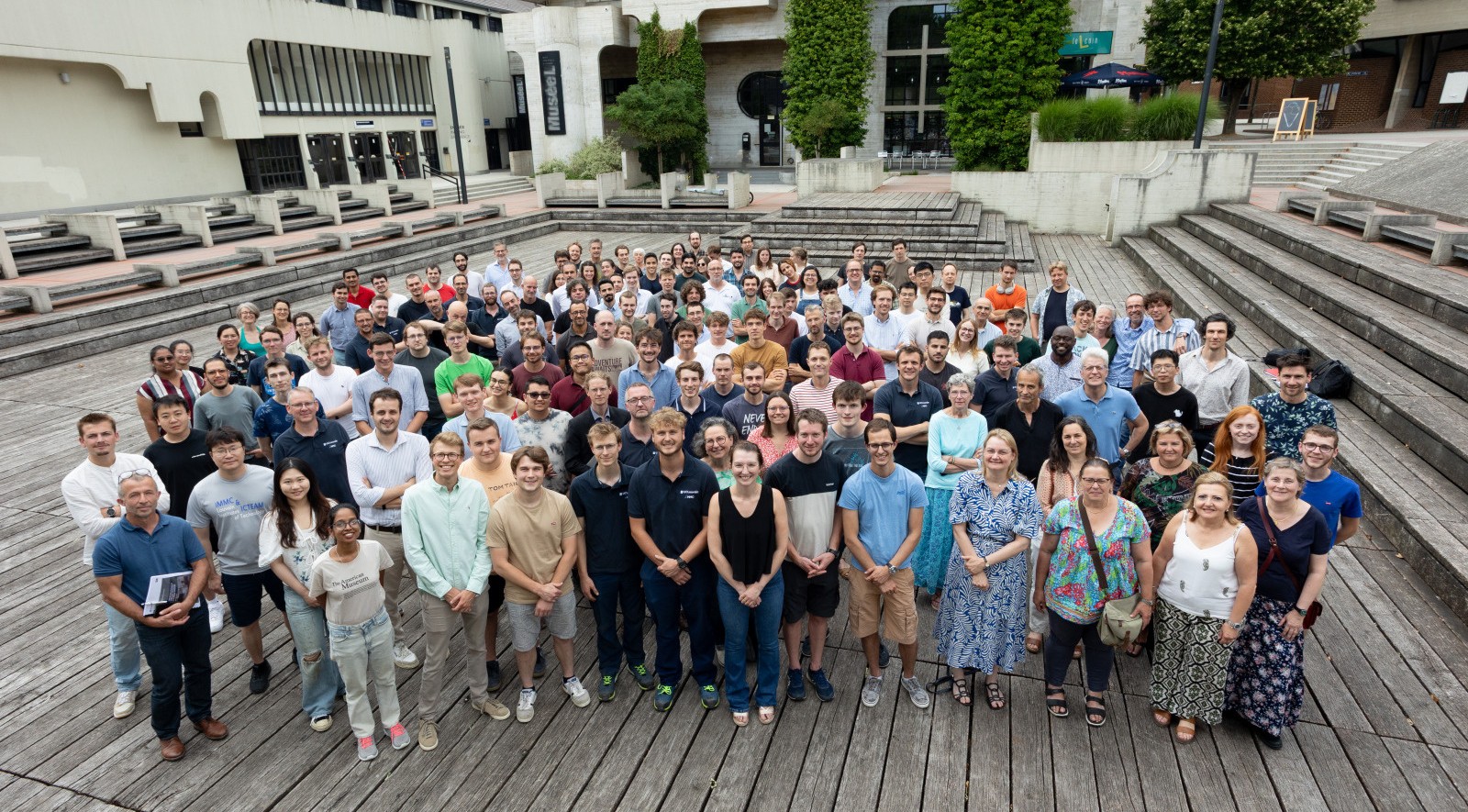
Welcome to the official page of iMMC (Institute of Mechanics, Materials and Civil Engineering)!
At iMMC, over 200 researchers are advancing knowledge and driving innovation in mechanics, materials science, and civil engineering.
Our mission? To deepen scientific understanding and develop solutions to real-world and pressing societal challenges. Through the creation of scientific knowledge and technological breakthroughs, we contribute to a better, more sustainable future across a wide range of domains: biomedical engineering, civil and environmental engineering, chemical engineering, computational engineering, dynamical and electromechanical systems, energy, fluid and solid mechanics, and materials processing and characterization.
Our goal: to contribute to happier humanity and sustainable development through impactful science.
iMMC in nombers

Discover our institute:
Latest news


Upcoming events
No events match your criteria.

PhD Defense: Computational fluid dynamics simulations of gas-electrolyte behaviour in alkaline water electrolysis cells by Kevin VAN DROOGENBROEK (IMAP)
Sustainable hydrogen is expected to play a significant role in the energy transition, as it offers a way to store and deliver usable and clean energy while avoiding direct carbon dioxide emissions at the point of use. The objective of this thesis is to propose strategies to enhance the performance of alkaline water electrolysis and thereby contribute to the development of more efficient electrolyser designs. To this end, computational fluid dynamics (CFD) simulations are used to investigate transport phenomena within water electrolysis cells at both laboratory- and prototype-scales. At laboratory-scale, the incorporation of flow-engineered, laterally graded bilayer electrodes within laboratory cells is considered under forced electrolyte flow conditions. Complex three-dimensional (3D) materials, such as metallic foams and triply periodic minimal surfaces (TPMS) structures, are investigated through a pore-resolved CFD approach. At prototype-scale, flow distribution is quantified using residence time distribution (RTD) analyses. Single-phase flow simulations are used to study flow uniformity and the presence of recirculation regions depending on the inlet configuration and the porous transport layer (PTL). Multiphase flow simulations are subsequently introduced to account for electrogenerated hydrogen bubbles and to investigate the influence of cell geometry on gas distribution and evacuation. Overall, the findings presented here suggest that unlocking the full potential of industrial alkaline water electrolysers will require a more integrated approach to electrolyser design, in which flow fields, porous electrodes, gas evacuation pathways, and cell architectures are co-designed. Such an approach provides a pathway towards more uniform liquid distribution, improved gas evacuation, and more efficient use of the active electrode area, thereby supporting the development and scale-up of high-performance alkaline water electrolysers.
Membres du jury :
- Prof. Joris PROOST (UCLouvain)(Promoteur)
- Prof. Aude SIMAR (UCLouvain) (Président)
- Prof. Juray DE WILDE (UCLouvain) (Secrétaire)
- Prof. Alessandro MONTEVERDE (Politecnico di Torino)
- Prof. Benoit SCHEID (ULB)
Soutenance publique également accessible par visio-conférence via le lien (TEAMS) :
https://teams.microsoft.com/meet/3384295413583438?p=R65BqdXQbIKZUkHibx

iMMCminar : Unexplained Explosions in Industrial Plants: The Search for the Hidden Ignition Source by Holger GROSSHANS
In many industrial explosions, investigators cannot identify the ignition source. This makes these explosions unpredictable and impossible to prevent. When no ignition source is found, electrostatic discharges are widely suspected as the cause. However, definite proof is usually lacking since the rise of electrostatic charge cannot be seen or smelled, and the explosion destroys valuable evidence. The central problem is the lack of a reliable method for measuring flow charging. The conventional measurement technique, the Faraday pail, only captures the net charge contained inside the pail. Thus, positive and negative charges can cancel each other, yielding a zero-charge reading even though the particles or droplets themselves may carry significant charge. To address these problems, we developed a new experimental method that can spatially resolve electrostatic charge distributions in turbulent flows. Applied to particle-laden flows, it identifies regions containing highly charged particles that were previously inaccessible. This new technology can find hidden ignition sources, thereby helping to prevent catastrophic incidents in the industry.

PhD Defense : « Le Rôle de l’Altération Hydrothermale dans l'Instabilité Mécanique des Édifices Volcaniques » par Jens NICLAES (GCE)
Les volcans sont souvent perçus comme des montagnes éternelles, mais ils peuvent pourrir silencieusement de l'intérieur. En profondeur, les fluides acides chauffés par le magma agissent comme un réacteur chimique continu : ils dissolvent lentement la roche et la remplacent par des minéraux faibles comme l'argile. Cette thèse étudie comment cette dégradation clandestine déclenche de gigantesques effondrements volcaniques.
En analysant les débris de l'effondrement du volcan Tutupaca (Pérou) en 1802, cette recherche a permis de retracer l'origine de la rupture dans une couche de roche intensément altérée, à près d'un kilomètre sous la surface. Les ingénieurs considèrent traditionnellement que les roches enfouies si profondément sont maintenues stables par la pression colossale de la montagne, l'empêchant de glisser. Cependant, des tests en laboratoire sur ces roches ont révélé une faille fatale : cette altération hydrothermale dégrade tellement les fondations que le poids du volcan finit par les écraser comme de la neige fraiche.
Un volcan n'a pas toujours besoin d'un événement déclencheur spectaculaire, comme un séisme ou une éruption, pour s'effondrer. Il peut s'altérer pendant des millénaires jusqu'à ce que sa base cède sous l'effet de la gravité. Identifier cet écrasement interne comme un mécanisme de rupture inhérent aux volcans offre aux observatoires un nouveau cadre mécanique pour surveiller la stabilité et anticiper ces effondrements profonds avant que la menace pour les populations ne se concrétise.
Membres du jury :
- Prof. Hadrien Rattez (UCLouvain)(Promoteur)
- Prof. Pierre Delmelle (UCLouvain)(Promoteur)
- Prof. Francesco Contino (UCLouvain) (Président)
- Dr. Jonathan Lambert (UCLouvain) (Secrétaire)
- Prof. Michael Heap (Université de Strasbourg)
- Dr. Thomas Poulet (CSIRO)
- Dr. Pablo Samaniego (Université Clermont Auvergne)
Soutenance publique également accessible par visio-conférence via le lien (TEAMS) :
https://teams.microsoft.com/meet/3291986728046677?p=GNaNtxpKfTzKKNPheP