

ELI member of the week: Emmanuel Hanert
eli | Louvain-la-Neuve
Every week, discover a new profile of a member of the Earth and Life Institute. This week, meet Emmanuel Hanert, professor and co-head of the ELI-E department.
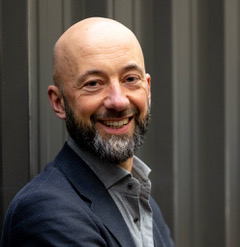
Could you briefly introduce yourself, your role, and the work you do in ELI?
I'm Emmanuel Hanert, a professor in the Faculty of Bioscience Engineering (AGRO) and a member of the Environmental Sciences research centre (ELI-E).
Like most professors, I juggle teaching (maths at bachelor level, modelling and data science at master level), research (more on that below) and administration, including co-heading ELI-E with Sophie Opfergelt.
Could you tell us a little about your research team and your research topics?
My group is currently composed of 13 researchers. They all develop and apply computer models of the ocean to simulate currents and waves. We use them to track where things drift in the water: coral larvae, turtle hatchlings, sediments, oil spills and much more.
We work in the North Sea, Florida, the Caribbean, the Red Sea, the Arabian Gulf, the Seychelles and on the Great Barrier Reef, always with local researchers.
Together, we help manage marine ecosystems, assess how vulnerable coasts are to pollution and extreme weather, and estimate the environmental impact of human activities.
What was your career path before taking up your current post in ELI?
I did a master's and a PhD in physics at UCLouvain, followed by a one-year FNRS postdoc.
I then spent three years as a lecturer in the Departments of Mathematics and Meteorology at the University of Reading in the UK, before returning to UCLouvain to join ELI and the Faculty of Bioscience Engineering.
In practical terms, what is your day-to-day life like?
No two days are alike. There's teaching, meetings with group members and master students going through their latest simulations, calls with partners in the Gulf, in Florida or in Australia, and in between, research proposals and ELI-E admin.
The best moments are when a simulation finally matches the field observations, which can take some time...
Do you have a hobby, a passion, a hidden talent, something you enjoy doing or care deeply about outside of work?
I love cooking, wine tasting and cycling, though preferably not in that order.
Can you name one thing you particularly appreciate at the Earth and Life Institute?
The mix of disciplines and the energy of all our master students, PhD researchers and postdocs. That's really stimulating!