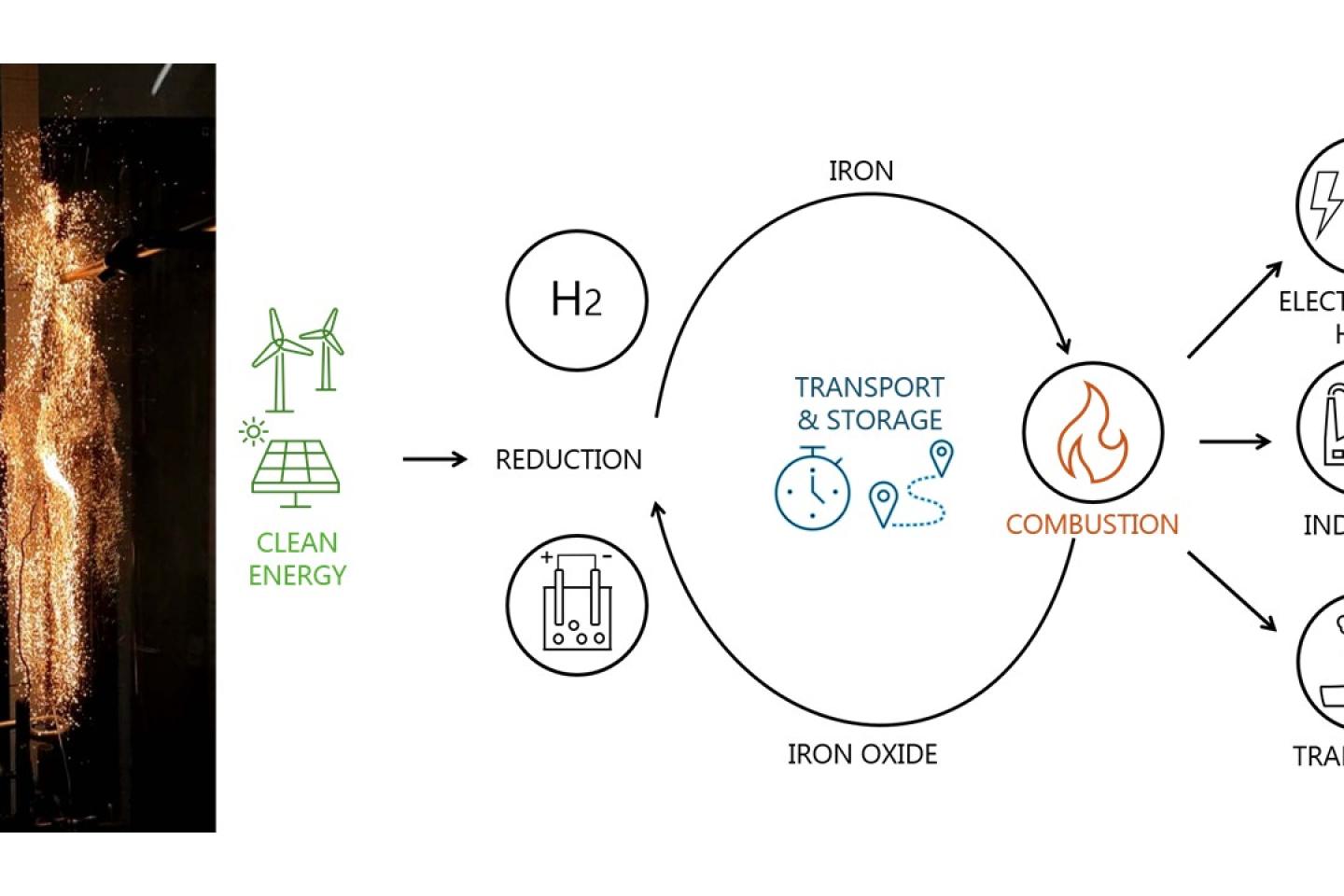
Future energy systems require efficient and safe storage and transport solutions to integrate intermittent renewable energy sources. Iron powder is a promising energy carrier because it is abundant, safe, inexpensive, and recyclable: after combustion, iron oxides can be reduced back to metallic iron using renewable energy, closing a sustainable energy cycle.
This thesis investigates the combustion of iron particles and the influence of impurities on their behaviour. Single-particle experiments were conducted in an electrodynamic levitator using different powder compositions.
For pure Fe particles, results revealed the coexistence of liquid iron and iron oxide phases at the particle surface during combustion. They also identified hydrogen, originating from hydroxide layers formed during storage, as a key contributor to micro-explosions.
Beyond high-purity iron powders, impure iron powders were also tested. Metallic impurities such as aluminum and silicon significantly modify combustion behaviour by altering particle morphology, oxidation rate, evaporation dynamics, and ignition temperature. Oxide impurities have a more limited effect but can still influence combustion mechanisms and oxide formation. Overall, the results demonstrate that impure iron powders can ignite and fully oxidize in the liquid state, supporting their potential use as sustainable metal fuels and highlighting the need for burner designs adapted to variable feedstock quality.
Membres du jury :
Prof. Francesco Contino (UCLouvain)(Promoteur)
Prof. Paul Fisette (UCLouvain) (Président)
Prof. Pascal Jacques (UCLouvain) (Secrétaire)
Prof. Fabien Halter (CNRS Orléans) (Co-promoteur)
Dr. Laurine Choisez (UCLouvain)
Dr. XiaoCheng Mi (TU Eindhoven)
Dr. Arne Scholtissek (TU Darmstadt)
Soutenance publique également via le lien (TEAMS) :
https://teams.microsoft.com/meet/31436901782842?p=vA5eJVIXn06nwytoqI