

Alumni Portrait: From LIDAM to Oncology Research
core |
“I wanted my research to have a direct impact”
How a PhD led Niranjana Prasad from economic models to oncology research
Before joining Johnson & Johnson to contribute to oncology research, Niranjana Prasad was already working at the heart of international economic research. Yet, through her interactions with experienced academics and researchers, she came to a clear realization: answering the most complex questions requires a deeper level of analytical expertise. That pursuit brought her to LIDAM. Several years later, the skills she developed during her PhD continue to shape her work every day, now in service of health research and patient outcomes.
When Niranjana Prasad reflects on what motivated her to pursue a PhD, she does not speak about academic titles or career prestige. Instead, she speaks about a realization.
Before joining LIDAM, she was already working in economic research. Her professional experiences allowed her to collaborate with leading researchers, both in the United States and at the World Bank, one of her former employers. Those interactions would ultimately shape the next chapter of her career.
“It became very clear to me that senior researchers possessed deeper and more versatile analytical skills. They were able to answer particularly complex questions.”
That observation became a turning point.
“I realized that developing those skills would be essential if I wanted to make meaningful contributions to research and advance in my career.”
Pursuing a PhD quickly emerged as the natural next step.
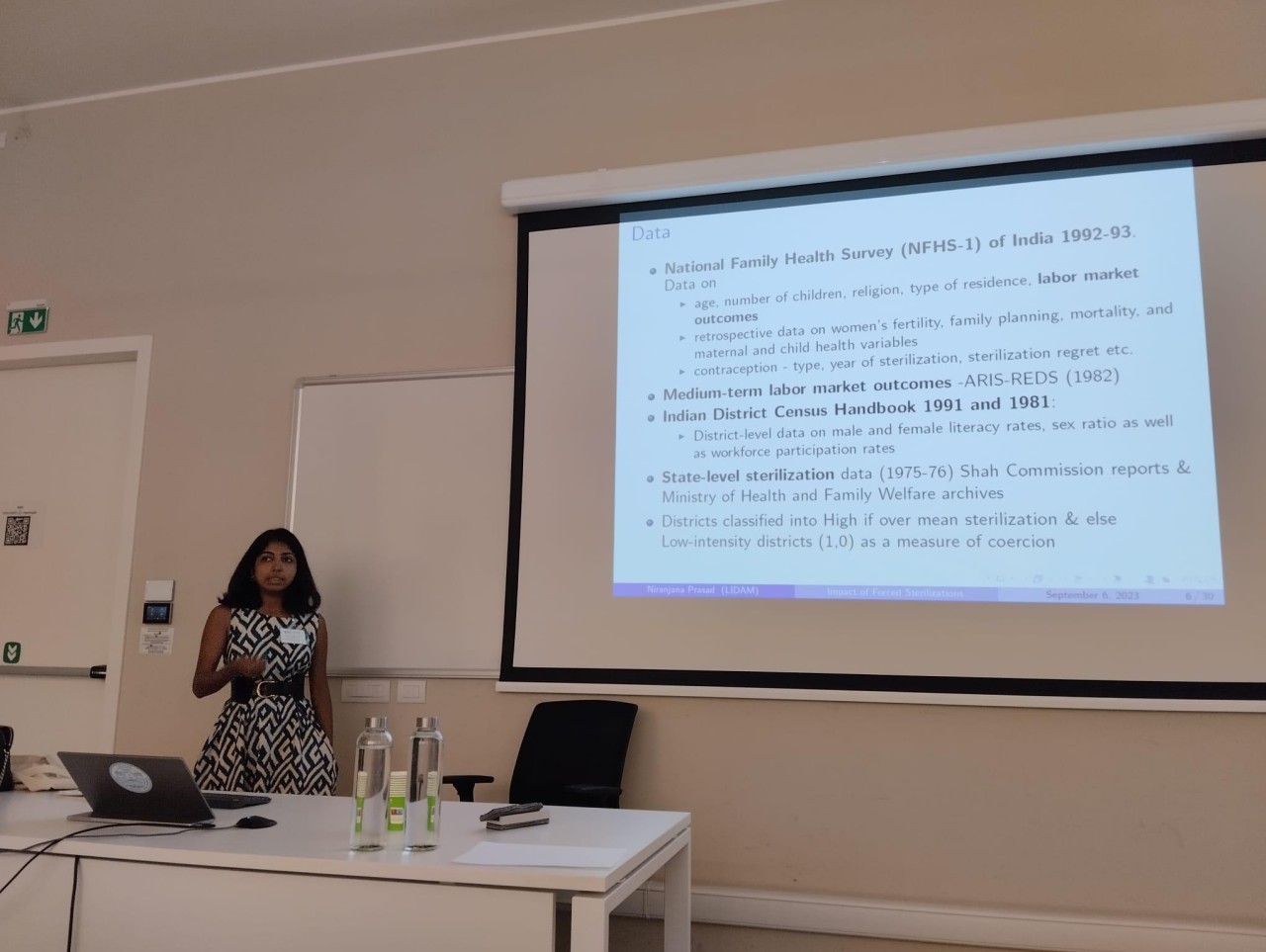
Finding the right environment to grow
When selecting a doctoral program, Niranjana was looking for much more than a research topic. She wanted an environment that would challenge and support her intellectual growth over the long term.
The faculty she could work with, the size of the department, the opportunities for scientific exchange, and practical considerations such as funding all played an important role in her decision.
“I wanted to be in a place where there were enough researchers to exchange ideas with, challenge assumptions, and help find solutions when you get stuck on a research problem.”
LIDAM offered precisely that balance between academic excellence, strong supervision, and an internationally connected research community.
Doing a PhD during a global pandemic
Niranjana began her doctoral journey at a time few researchers could have anticipated: the onset of the COVID-19 pandemic.
For a young researcher just starting her academic career, the experience was not without challenges. Informal interactions disappeared, conferences were cancelled, and much of the work took place behind a screen.
“It was quite an isolating experience for a junior researcher.”
Despite these circumstances, regular meetings with her supervisor provided stability and support, helping her navigate the uncertainties of the period and continue progressing with her research.
A major milestone came when she was awarded an FNRS-FRESH scholarship.
“The scholarship opened many doors, especially in terms of conference participation.”
Those opportunities proved invaluable to her development as a researcher.
“Conferences always strengthen research. Discussions with other researchers bring new perspectives and help improve the quality of your work.”
Beyond technical expertise and publications, one lesson stands out from her doctoral years.
“It is important to build a strong network of senior researchers and never be afraid to ask for help.”
Choosing impact: from econometrics to health research
As the end of her PhD approached, Niranjana began reflecting on what she wanted from the next phase of her career.
One thing was certain: she wanted to continue conducting rigorous research. But she also wanted her work to generate a more immediate and tangible impact.
Health research quickly emerged as the ideal field in which to combine scientific rigor with real-world relevance.
“I wanted to continue producing methodologically rigorous research, but I also wanted my work to have a direct impact, particularly in the field of health.”
That ambition eventually led her to Johnson & Johnson.
Today, she serves as a Fellow in Real-World Evidence (RWE), applying econometric methods, causal inference techniques, and advanced data analytics to answer critical research questions in oncology.
For her, the pharmaceutical industry offers a uniquely stimulating environment.
“A company like Johnson & Johnson allows you to conduct rigorous research while also benefiting from extensive mentorship and professional development opportunities.”
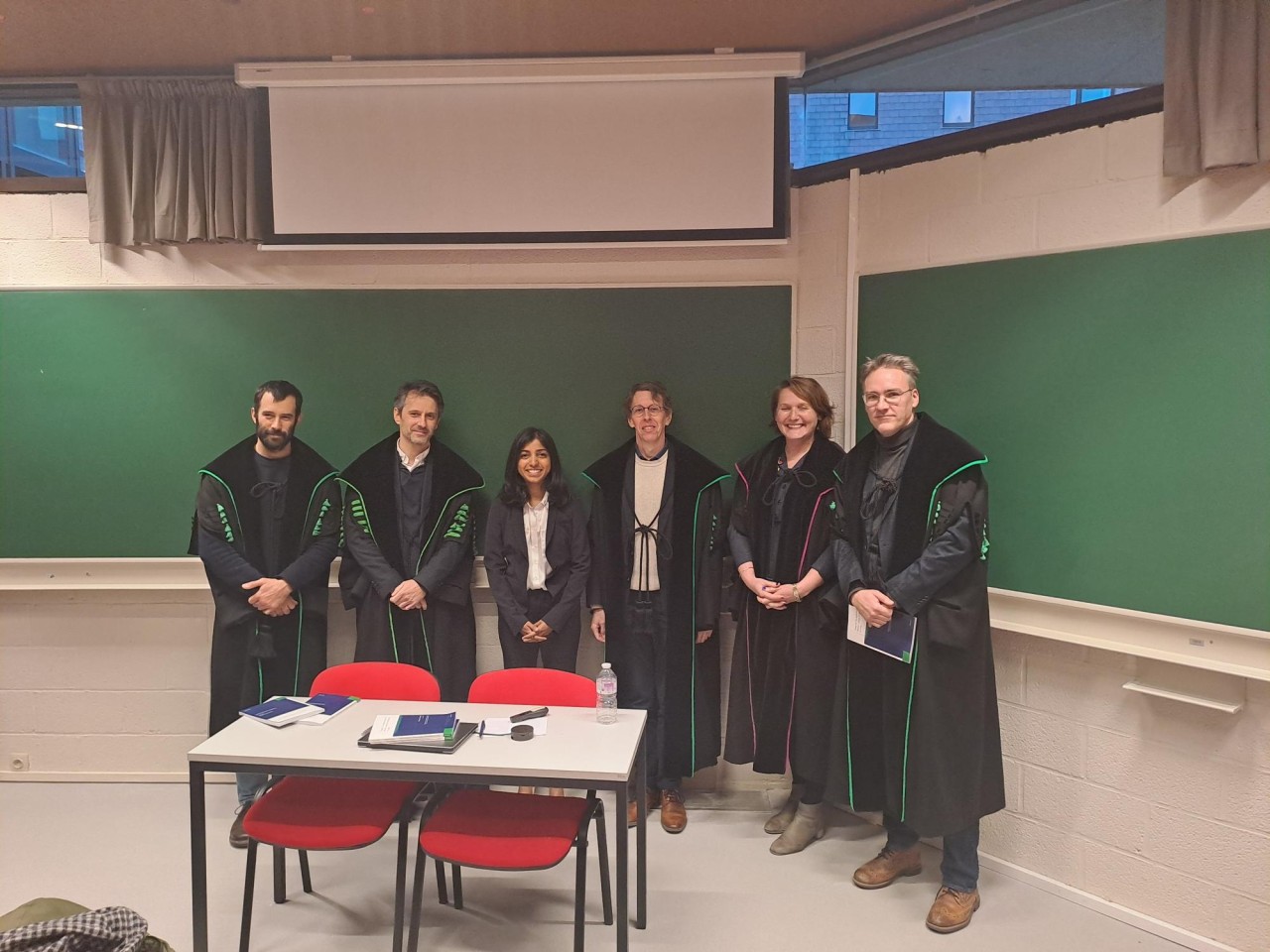
When doctoral skills become a professional advantage
Several years after completing her PhD, Niranjana still relies on the skills she developed during her doctoral training every day.
The ability to structure complex problems, critically assess evidence, and design robust methodologies remains central to her work.
“My PhD trained me to think critically about research questions, approach problems in a structured way, and apply rigorous analytical methods.”
In practice, this means designing robust studies, working with complex real-world datasets, and ensuring that research findings are both scientifically sound and meaningful.
Contrary to common assumptions, she sees many similarities between academic and industry research.
“My current role is actually quite similar to academic research, except that the timelines are shorter.”
Today, she conducts applied statistical research in oncology, producing scientific abstracts and manuscripts that contribute to advancing knowledge in cancer research.
Advice for future PhD candidates
When speaking to students considering a doctorate, Niranjana does not romanticize the experience.
Instead, she encourages clarity and self-reflection.
“Be very clear about why you want to pursue a PhD in the first place.”
While intellectually rewarding, doctoral studies also come with uncertainty, long timelines, and periods when progress can feel slow.
“A PhD is a substantial commitment. There will be moments when progress feels slow and uncertainty becomes part of everyday life.”
For those who aspire to develop deep expertise, strengthen their analytical skills, and contribute to advancing knowledge, however, the investment can be transformative.
And when asked whether she would make the same decision again, her answer comes without hesitation.
“Absolutely. In a heartbeat.”
A simple yet powerful statement that captures the lasting impact her doctoral experience has had on both her professional and personal journey.
Today, the skills she cultivated at LIDAM are helping her contribute to one of the most important scientific and societal challenges of our time: advancing research that can ultimately improve patients’ lives.

At a glance
An economist by training, Niranjana Prasad has built a career spanning international organizations, economic consulting, and academia. After completing a PhD in applied econometrics at LIDAM, she chose to apply her analytical expertise to health research. Today, as a Fellow in Real-World Evidence at Johnson & Johnson, she uses real-world data and causal inference methods to advance oncology research and support evidence-based healthcare decision-making.