

Nos séminaires et rencontres
l4water |
Nos séminaires et rencontres
Aucun événement ne correspond à vos critères

18/10/2023 - Adaptation of agriculture to water scarcity
WORLD FOOD DAY 2023
Academic seminar on the Adaptation of Agriculture to water scarcity
Co-organised by Université Catholique de Louvain (UCLouvain), Circle U. European University Alliance, Agro-Louvain, Earth and Life Institute, Louvain4Water and Unesco-IHP Belgian chapter
With the technical support by FAO Brussels Liaison Office
| Auditoires Montesquieu (MONT 01) Rue Montesquieu 2 Louvain-la-Neuve, Belgium |
 World Food Day (16 October) is internationally celebrated and is an occasion to promote worldwide awareness of hunger and promote action for the future of food, people and the planet. It also commemorates the date of the founding of the FAO in 1945. In 2023, the focus is on the theme “Water is life, water is food. Leave no one behind.”.
Water is a driving force for people, economies and nature and the foundation of our food. Indeed, agriculture accounts for 72% of global freshwater withdrawals, but like all natural resources, fresh water is not infinite.
Rapid population growth, urbanization, economic development, and climate change are putting the planet’s water resources under increasing stress. At the same time, freshwater resources per person have declined 20% in the past decades and water availability and quality are deteriorating fast due to decades of poor use and management, over extraction of groundwater, pollution and climate change. We risk stretching this precious resource to a point of no return.
Today, 2.4 billion people live in water-stressed countries. Many are smallholder farmers who already struggle to meet their daily needs, particularly women, Indigenous Peoples, migrants, and refugees. Competition for this priceless resource is increasing as water scarcity becomes an ever-increasing cause of conflict.
We need to produce more food and other essential agricultural commodities with less water, while ensuring water is distributed equally and nobody is left behind.
This event aims to reflect on the current evidence on addressing water scarcity in the agricultural sector and to come up with a priority agenda for future research.
Reference will be made to The Global Framework for Action to Cope with Water Scarcity in Agriculture in the Context of Climate Change (WASAG). This is a Partnership hosted by FAO and consisting of government agencies, international organizations, research institutions, advocacy groups and professional/membership organizations. WASAG fosters collaboration among its partners for the development and deployment of policies, strategies, and programmes, enhancing field capacity for the adaptation of agriculture to water scarcity.
A first panel will reflect on the situation in Belgium, a second panel will zoom out and consider the international state-of-play.
In Belgium, a large population inhabiting a small area and water-intensive sectors in agriculture and industry lead to a high water consumption. Moreover, excessive paving in urban areas, canals and drainage pipes prevent water from soaking into the soil. Climate change is also causing longer periods of drought alternating with heavy rainfall. These factors make Belgium vulnerable to water scarcity and drought. At different policy levels, action is undertaken, i.e. the national Climate Adaptation Plan, the Flemish Blue Deal and the Walloon Committee of Climate Experts.
At international level, 2023 was an important year for water action. In March, the UN Water Conference resulted in a global Water Action Agenda, where commitments for accelerated implementation and improved impact on SDG 6[1] are gathered. In July, the FAO Conference adopted water as the biannual theme for the Organization’s work in 2024-25.
The event will be held in English.Programme and Presentations
|
Introduction |
||
|
Welcoming remarks |
14h00-14h15 |
Moderated by Paulo de Lima, FAO Liaison Office, Bruxelles
|
|
14h15-14h30 |
Video presentation of the FAO World Food Day | |
|
Session 1: Adapting agriculture to water scarcity in Belgium |
||
|
14h30-15h45
(5 à 10 presentation by partner)
(20 minutes of debate) |
Moderated by Marnik Vanclooster, head of the Earth and Life Institute, UCLouvain
Panel members:
|
|
Coffee Break |
15h45-16h15 |
|
|
Session 2: Adapting agriculture to water scarcity at world-scale |
||
|
16h15-17h30
(5 à 10 presentation by partner)
(20 minutes of debate) |
Moderated by Vincent Legrand, UCLouvain
Panel members
|
|
Closing remarks |
17h30-17h40 |
Marnik Vanclooster, head of the Earth and Life Institute, UC Louvain Vincent Legrand, UCLouvain |
Partnership
As a knowledge institute, FAO has always cherished good partnerships with academia. With the fourth renewal of the Memorandum of Understanding upcoming, the collaboration with UC Louvain is a good example of this. This specific partnership aims to increase access to and exchange of information, knowledge and expertise in the field of climate change adaptation and mitigation and combating desertification with direct benefit for the services that FAO can provide to its members within the framework of a Better Production and a Better Environment and the SDGs 2, 13 and 15.
The Louvain4water is a platform within UC Louvain that aims to address the complexity of water through a multidisciplinary research platform for developing fundamental and applied research activities, advanced training programmes and services related to water. It develops projects in water resource management, risk management (floods, drought, pollution, conflict), political and socio-economic governance, exploitation and distribution and health and sanitation.
The event will be organized in the frame of the Circle U. Knowledge Hubs on Climate, of which Prof. Marnik Vanclooster (UCLouvain) is chair. This will enable the (virtual) participation of students and scholars from 8 different European Universities, namely Aarhus University, University of Belgrade, Humboldt-Universität zu Berlin, King’s College London, University of Oslo, Université Paris Cité, University of Pisa and University of Vienna.
The UNESCO Intergovernmental Hydrological Programme (IHP), founded in 1975 following the International Hydrological Decade (1965-1974), is the only intergovernmental cooperation programme of the UN system dedicated to water research and management, and related education and capacity development. It addresses national, regional, and global water challenges, by supporting the development of sustainable and resilient societies. Expanding a holistic understanding of water, improving technical capabilities, and enhancing human and institutional capacities are IHP’s main tools. IHP’s work supports sound, evidence-based water governance and decision-making drawing on transdisciplinary science and technology other knowledge systems. The UNESCO-IHP Belgian chapter is currently chaired by Prof. Ann van Griensven (VUB & IHE).
Moreover, the event will include contributions from other Belgian universities, namely KU Leuven, Université de Liège, UGhent, UAntwerp, VUB and ULB.
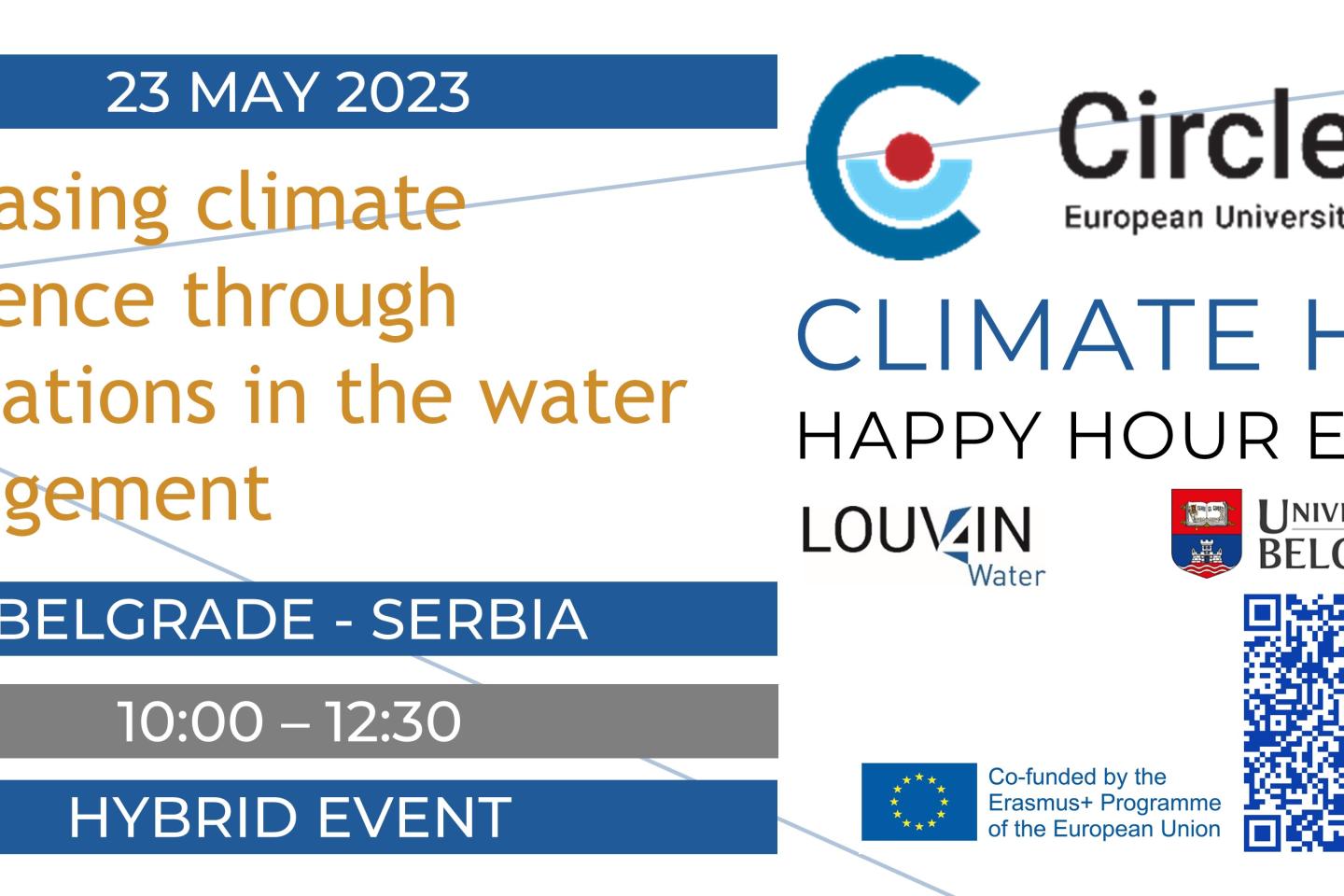
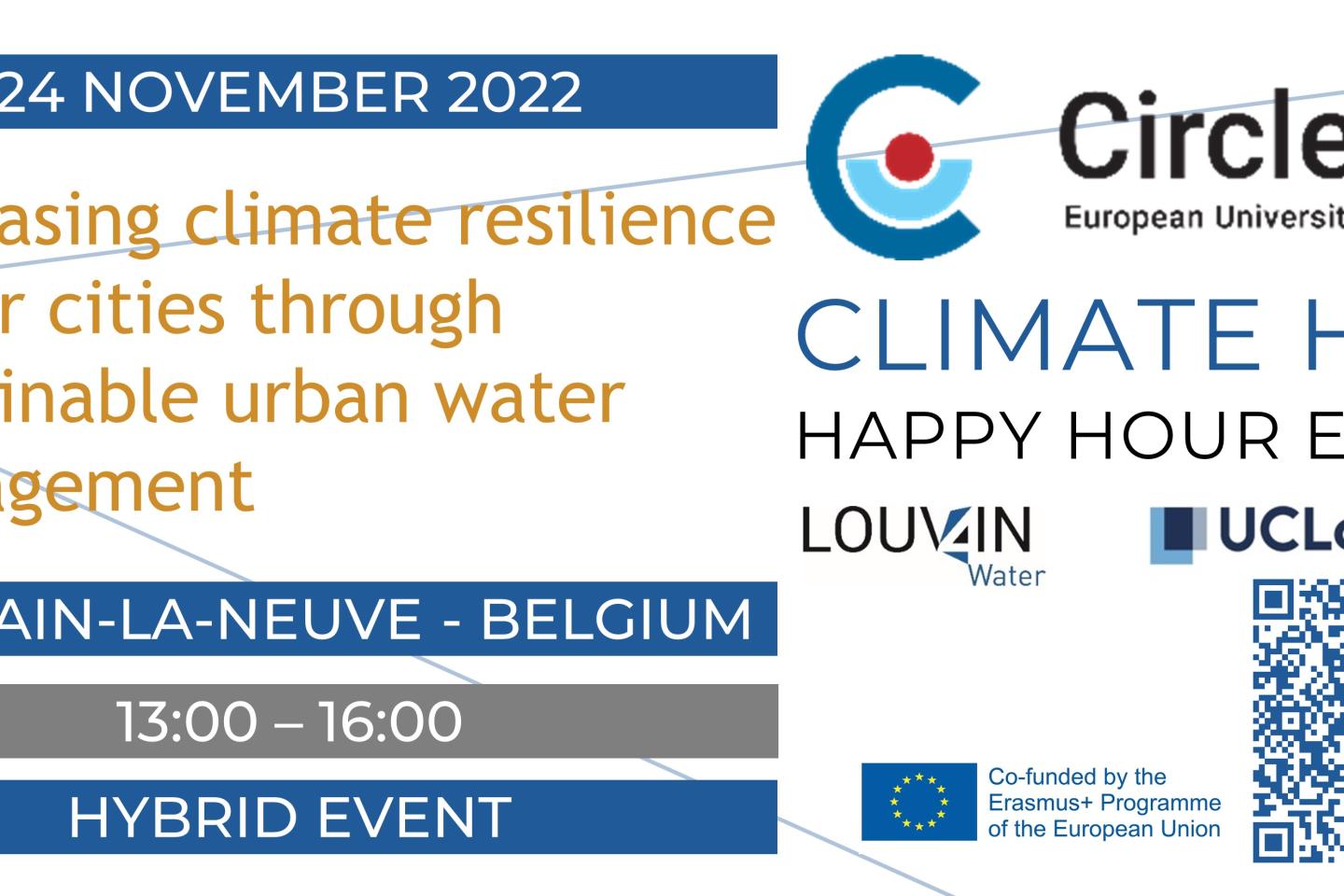
24/11/2022 Circle U. Climate Hub 1st Happy Hour Event
Increasing climate resilience of our cities through sustainable urban water management
Date: 24 November 2022, 13:00 - 16:00
Location: Hybrid format: Virtual (via Teams ) and Louvain-la-Neuve, Belgium (Earth & Life Institute, Bâtiment de Serres, UCLouvain).
Target Audience: Circle U researchers (PhD students, others, …) interested in climate science, water management and urban planning.
Organisers:
- Circle U, Climate Hub
- Louvain4Water
Background of Circle U, Climate Hub, Happy Hour Event (HHE)
The overall objective of the Happy Hour Event is to strengthen the partnership between Circle U units within the “Climate Change Knowledge Hub”. We believe that this needs a better understanding of the partners’ different thematic research fields and available specific expertise.
The Circle U, Climate Knowledge Hub, Happy Hour Events (HHE) are organized to reach this objective. An HHE is a short scientific event (typically lasting no more than 3 hours), consisting in two keynote lectures (one from the natural sciences and one from the human science domain), followed by a debate, a set of small pitch presentations and a final debate. The HHE is targeted to young researchers and doctoral students of the different partners. The participation in an HHE is certified by the organisers and can be included in the participants’ portfolio of research training.
Scope and objectives of the Circle U knowledge hub first Happy Hour Event
The current projected climate change for western Europe suggests an acceleration of the hydrological cycle, and hence predicts for the coming decades an increase of exceptional meteorological events such as heat waves, droughts, or catastrophic rainfall and flooding events. Such speeding up of the hydrological cycle adds considerable burden on the quality of life, in particular in urban environments, and calls for additional urgent measures to make European cities climate resilient. The adaptation of urban water infrastructure and water management is often considered as a key to face this challenge and to make cities more resilient to climate change. Yet, designing climate resilient water infrastructure for urban environments should be based on a thorough understanding of the hydrological processes in urban settings. In this happy hour, scientific advances supporting climate resilient water management for urban environments will be discussed.
Format of the Happy Hour Event
Two keynote lectures will allow to present specific cases dealing with climate resilience, hydrological issues and water management in urban environments.
A call is made for PhD students and researchers of Circle U to present a pitch presentation of scientific studies related to urban water management and infrastructure adaptation to face the challenges of climate change in urban environments. Contributions are solicited on the following topics
- Extreme hydroclimatic observations in urban environments
- Hydroclimatic models for urban environments
- Water management infrastructure to reduce flooding and extreme drought impacts
- Restoration of natural watersystems in urban environments
- Nature based solutions for making cities blue and green
- Innovation in water production, water distribution and water sanitation
- People engagement to contribute to blue resilient water cities
Submission format and deadline
PhD students and researchers of Circle U. are invited to submit their pitch proposals in the following format
- Name
- Affilitiation
- Abstract
Pitch proposals should be submitted before 17/11/22, 24h00.
Selected pitch proposals will be invited for a pitch presentation of 3 minutes + 2 minutes of discussion.
Publications and certifications
The oral and pitch presentations will be registered and will be made available on the web site of the event
A book of abstracts will be made available on the web site of the event
A certificate of participation will be delivered to participants
Preliminary programme
13h00-13h20 - Keynote lecture: "How does Paris impact heavy metal transfer in the Seine river?". Prof. Alexandre Gelabert, U Paris.
13h20-13h30 - Q&A
13h30-13h50 - Keynote lecture: “Flooding in Walloon Brabant: from a transdisciplinary diagnosis to transdisciplinary actions?.” Prof. Jean Philippe de Visscher, LAB, UCLouvain.
13h50-14h00 - Q&A
14h00-15h00 - An ensemble of PhD pitch presentations (3 min presentation per pitch, 2 min questions – discussion per pitch). To be confirmed after 14/11/22
15h00-16h00 - Panel and final discussion
16h00-16h15 - Transfer to downtown Louvain-la-Neuve to participate to the Circle U. conference “INCREASING THE CONTRIBUTION OF TRANSDISCIPLINARY RESEARCH TO ACCELERATING SUSTAINABILITY TRANSITIONS”
This project has received funding from the European Union’s ERASMUS+ Programme under grant agreement No 101004062
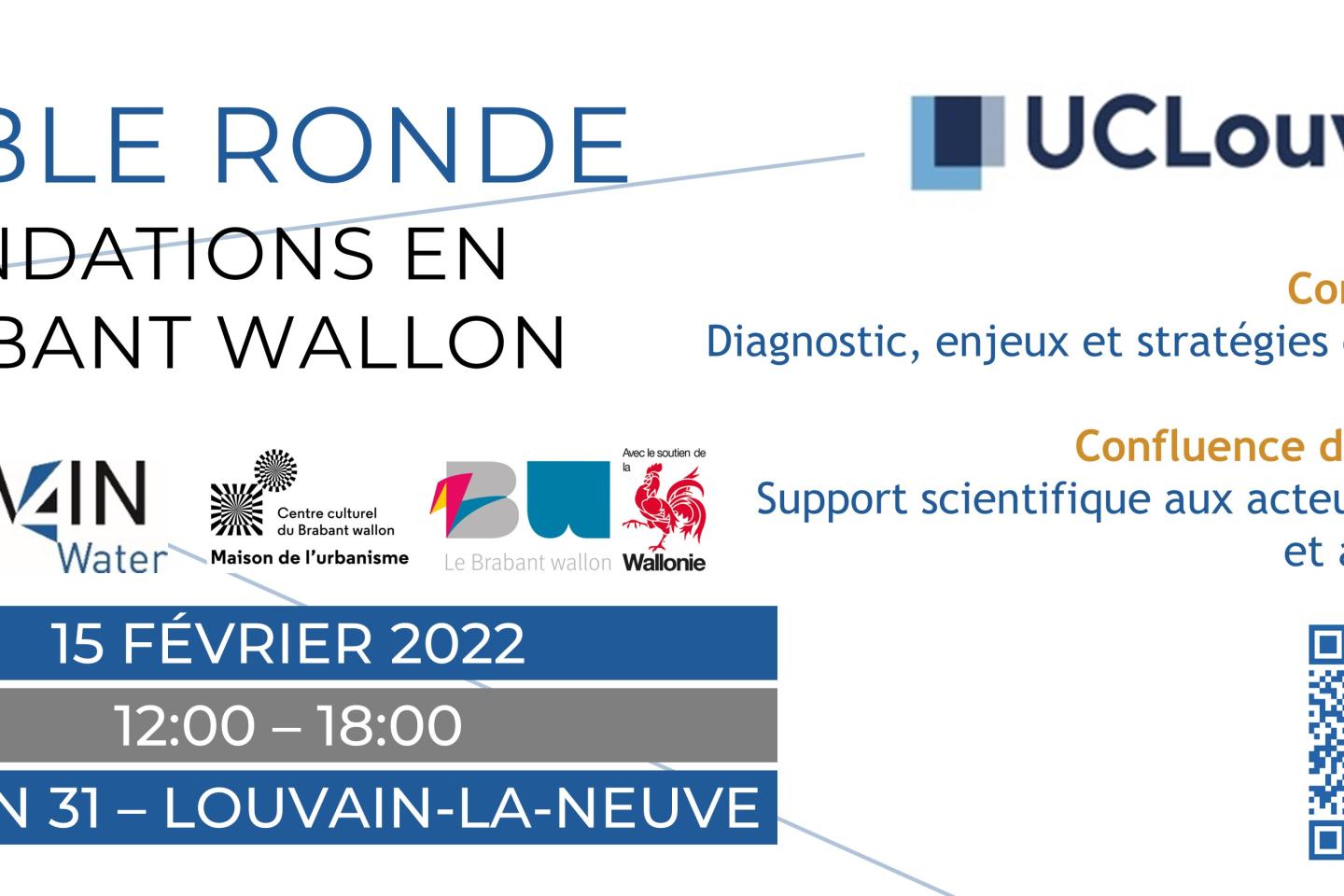
15/02/2022 - Table ronde Inondations Brabant wallon
Auditoire Doyen 31
Place des Doyen, 1 - Louvain-la-Neuve
15 février 2022
La plateforme de recherche interdisciplinaire Louvain4Water et la Maison de l’Urbanisme du Brabant Wallon, en partenariat avec la Plateforme provinciale de gestion des risques d'inondation, ont le plaisir de vous inviter à la table ronde consacrée à la problématique des inondations en Brabant wallon qui se déroulera le 15 février 2022 à Louvain-la-Neuve.
L’objectif sera de :
- Aider à comprendre les causes des inondations qui ont secoué certaines communes du Brabant wallon en juillet dernier.
- Offrir un support scientifique aux acteurs publics (communaux, provinciaux et régionaux) et associatifs dans la conception et la mise en œuvre de stratégies d’adaptations aux risques d’inondations en Brabant wallon
- Favoriser la confluence de savoir et savoir-faire entre experts, étudiants et acteurs de terrains face aux risques d'inondations
Programme
12h00 Accueil
12h30 Introduction par Mme Sophie Keymolen, députée provinciale en charge de l’aménagement du territoire et présidente de la Maison de l’urbanisme et M. Marc Bastin, député provincial en charge de la lutte contre les inondations.
13h00 - 14h00 Diagnostic, enjeux et stratégies existantes sur la problématique des inondations en Brabant wallon par les chercheurs de l’initiative Louvain4Water
14h30 - 16h00 Ateliers thématiques au choix :
- Atelier A. Plateaux agricoles : réflexion sur les problèmes de coulées de boues dans un village sur le haut du plateau
- Atelier B. Pentes : réflexion sur les problèmes de confluences des eaux de ruissellement vers des vallées encaissées et habitées.
- Atelier C. Fonds de vallée : réflexion sur la gestion des inondations dans les zones de grands équipements, d’infrastructures et de développement immobilier.
16h30 - 18h00 Compte-rendu des ateliers et débat
La table ronde se tiendra, en présentiel, à Louvain-la-Neuve. L’accueil et les sessions plénières se tiendront dans l’Auditoire Doyen 31.
Informations pratiques
Auditoire Doyen 31
Collège des Doyens
Place des Doyens, 1
1348 Louvain-la-Neuve
Les sessions parallèles se tiendront dans des salles de séminaires proches de l’auditoire Doyen 31.
Le Collège des Doyens est accessible à pieds depuis la gare SNCB de Louvain-la-Neuve ou depuis la gare des bus. Le parking le plus proche est le parking souterrain Grand Place.
Participation à distance
Dans la mesure du possible, la participation et la retransmission en ligne des échanges sera organisée via TEAMS. Les informations pratiques seront communiquées par email quelques jours avant la rencontre.
04/03/2020 Louvain4Water Seminar - Real Cool - Research through Design for Cool Urban Water Environments
Wednesday 04 March 2020
14:00 - 18:00
Auditoire Gerty Cori
Tour Laennec, 57 - Woluwe
Registration
The objective of the Louvain4Water Seminars is to strengthen the network of researchers and other actors working in the water domain at UCLouvain and identify common actions in this domain.
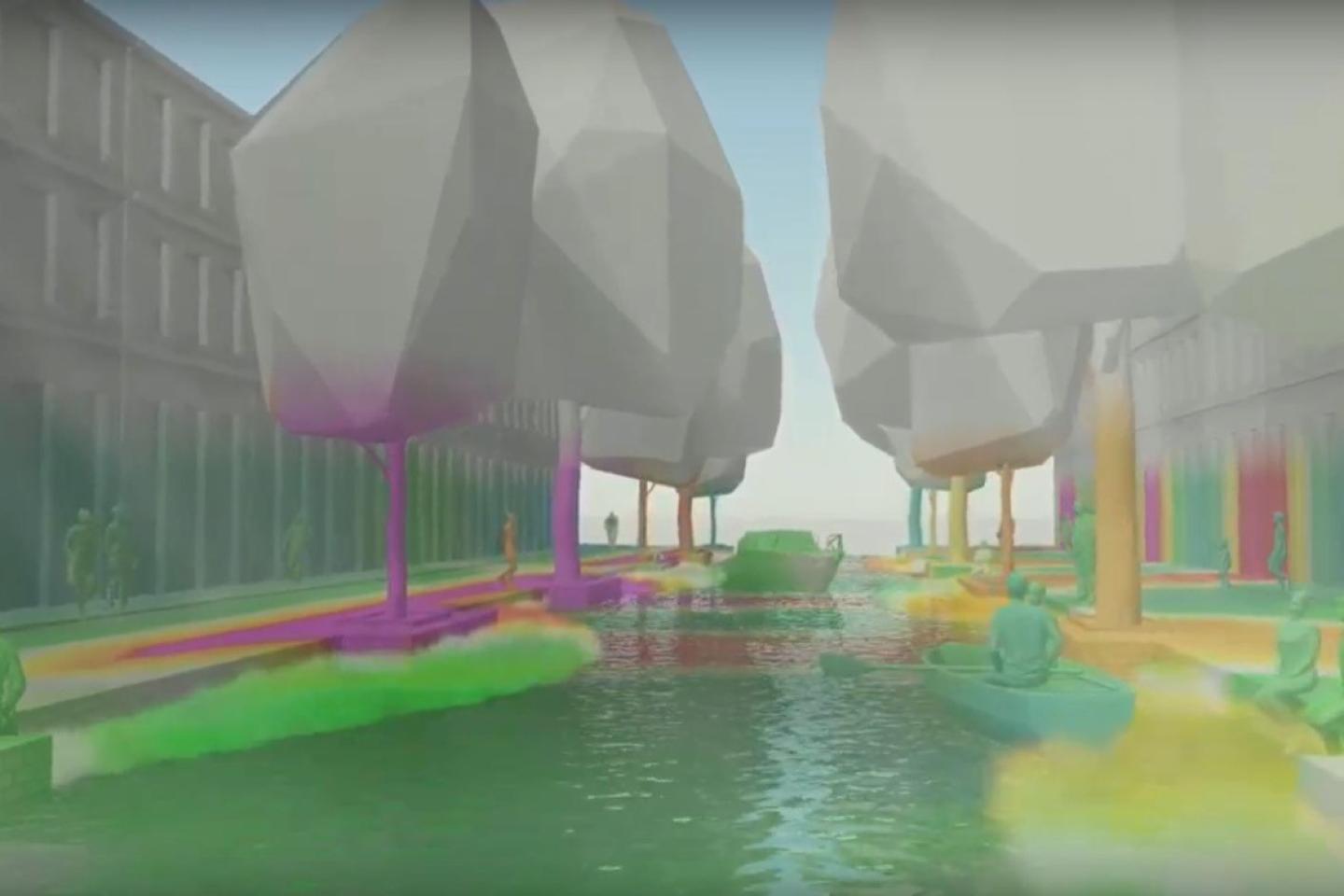
For this meeting, we are pleased to receive Prof. Sanda Lenzholzer (Wageningen University and Research Centre WUR) who will give a keynote speech on the project "REALCOOL - Research through Design for Cool Urban Water Environments".
In addition to this, the Louvain4Water Seminar will offer its members the opportunity to pitch their research works on topics related to water (app. 3 minutes per presentation). Please do not hesitate to contact us through the registration form below if you wish to present your work. The presentation can equally be in French or English.
Keynote by Prof. Sanda Lenzholzer (Wageningen University and Research Centre WUR) REALCOOL - Research through Design for Cool Urban Water Environments
Urban design practitioners believed that urban water bodies (such as canals, ditches or ponds) can solve urban heat problems but recent research shows that the cooling effect of large water bodies during summer is limited over day and can actually induce a night-time warming effect. But what is the situation around small water bodies and how can they provide cooling for their environment? This was studied in the ‘Really cooling water bodies in cities’ (REALCOOL) project. In a Research Through Design process we explored the most effective combinations of shading, water vaporisation and natural ventilation to cool smaller water bodies. It showed that the water itself cannot be cooled effectively, but that the environment of the water bodies can be cooled: shading was the most important factor followed by openness to wind and evaporating water through fountains and sprays. We created virtual prototypes/ design guidelines that we tested according to criteria such as water-storage capacity, compatibility with other urban functions, costs, maintenance and effects on public health. Our user committee concluded that the final prototypes can be easily applied in design practice.
Pitches presentations
To be announced.
Location
Auditoire Gerty Cori
Tour Laennec, 57
1200 Woluwe-Saint-Lambert