

Groundbreaking Seismic Test of Non-Planar Thermoplastic GFRP-Reinforced Concrete Wall
immc | Louvain-la-Neuve
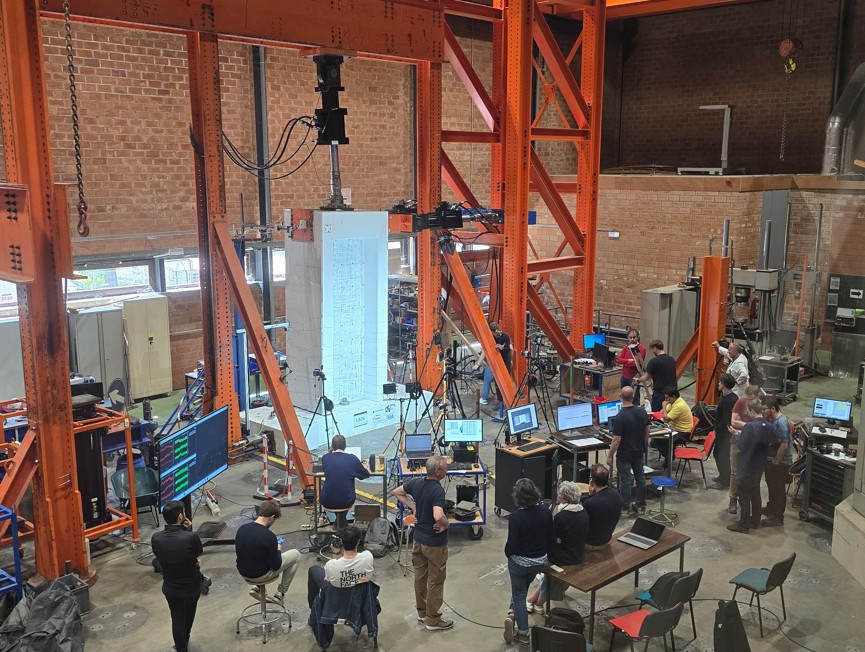
On 28 and 29 of April, researchers from Civil and Environmental Engineering, together with technicians and engineers of the Laboratoire Essais mécaniques, Structures et Génie civil (LEMSC), at iMMC, and a visiting scholar from EIA University in Colombia, conducted a large-scale seismic test on a reinforced concrete (RC) wall using with Glass Fibre Reinforced Polymer (GFRP) reinforcement. GFRP reinforcement is a promising alternative to the commonly used steel rebars in concrete construction.
The literature shows only a few GFRP-reinforced walls tested internationally. To our knowledge, this is the first time a non-planar wall is tested using fully recyclable thermoplastic GFRP rebars. The I-shaped cross-section was chosen to investigate its potential to enhance the displacement capacity and energy dissipation of these members, which become increasingly important as seismic hazard increases. The initial analysis of the results confirms its effectiveness.
Not only were the instrumentation and testing carried out at LEMSC, but also all steps of the GFRP cage and formwork assembly, as well as the concrete placement and casting. The scale and complexity of this test cannot be overstated. The wall specimen—approximately 4 metres tall including its foundations—employed a suite of advanced data acquisition technologies, including distributed fibre-optic sensing, digital image correlation, and motion capture. The corresponding data will be shared with the broader research and engineering communities.
Walls are the most common lateral load-resisting elements in modern construction, forming the structural backbone of millions of mid- and high-rise buildings worldwide. However, the steel bars traditionally used to reinforce these walls are susceptible to corrosion, which can compromise long-term durability, structural integrity, and seismic performance. GFRP is a promising alternative: a corrosion-resistant, non-conductive material with high tensile strength that could offer a longer-lasting and more resilient solution for reinforced concrete structures. The insights gained from this test will contribute to the development of future design standards and may pave the way for the broader implementation of GFRP-reinforced concrete structures—supporting the global pursuit of more resilient, durable, and sustainable buildings.
We extend our sincere gratitude to everyone involved in this significant achievement, especially the LEMSC laboratory technicians, engineers, and director, whose expertise and dedication were key to this project's success. We are also grateful for all the support and rebars provided by Sireg.


