

Nature of Anti-Dissipative High-Energy Excited States in Quaterpyridine-Bridged Ruthenium Complexes
imcn | Louvain-la-Neuve
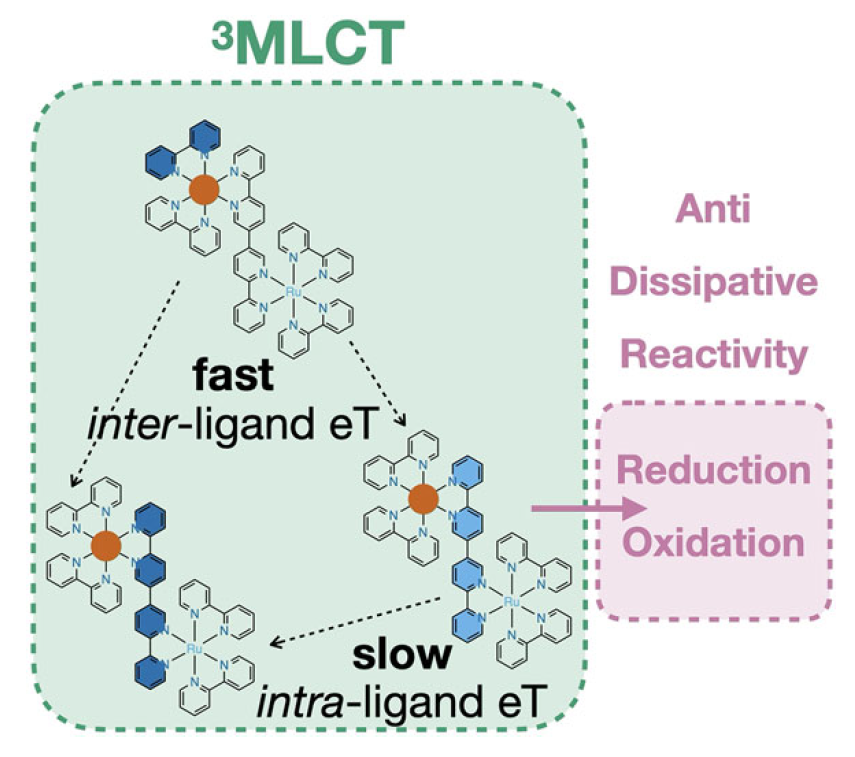
High-energy excited states with slow rates for internal conversion to the lowest-energy excited state are prone to be intercepted before they dissipate energy to the medium.
In a previous report, oligomeric Ru(II) photosensitizers bearing a bridging 2,2’:5’,3’’:6’’,2’’’-quaterpyridine scaffold showed promising anti-dissipative behavior in photoinduced electron transfer reactivity.
In here, a range of electron accepting and electron donating substituents were incorporated on the ancillary 2,2’-bipyridine ligands to modulate the excited-state dynamics. This allowed to unambiguously identify the precise nature of high-energy excited states, and derive design guidelines for the achievement of anti-dissipative behavior in oligomeric Ru(II) polypyridines relevant for solar fuels production and photoredox catalysis.
Authors : Noémie Chantry, Agustina Cotic, Simon De Kreijger, Riccardo Di Forti, Benjamin Elias, Ludovic Troian-Gautier, Alejandro Cadranel
https://doi.org/10.1002/anie.202507738