

From Taipei to Paris: Jing-Rong Zeng’s international journey through a PhD
ires |
Pursuing a PhD often means embracing uncertainty as much as intellectual discovery. For Jing-Rong Zeng, now a Postdoctoral Fellow at the Paris School of Economics, this journey has been shaped by international mobility, funding challenges, and a gradual but profound transformation into an independent researcher. Her story offers valuable insights for future PhD candidates and the LIDAM community.
Why pursue a PhD and why at LIDAM?
For Jing-Rong Zeng, the decision to pursue a PhD was guided by three key factors: funding, timeline, and alignment of research interests.
After completing her undergraduate studies in Taipei, followed by master’s degrees in Barcelona and Tilburg, she was looking for a research environment that matched her academic ambitions.
“I am interested in development economics and political economy. LIDAM offered a strong concentration of faculty working in these areas, which made it the right fit for me.”
The support of her supervisor, Professor Joseph Gomes, and the possibility of applying for competitive research funding through FNRS were also decisive. Thanks to her prior research training, she was able to move directly into the thesis phase, a flexibility offered by LIDAM and the Economics School of Louvain.
Navigating challenges and learning resilience
Jing-Rong’s PhD experience was marked early on by uncertainty, particularly around funding.
Despite several unsuccessful applications to FNRS grants, she was able to continue her research thanks to the strong support of her supervisor, who helped her identify alternative funding sources.
“It was a stressful period, but it taught me how to deal with uncertainty something that is inherent to any research career.”
Another challenge she reflects on today is the sense of isolation she experienced in the early stages of her PhD.
“I was working quite independently and didn’t always know how to reach out when I was stuck. In hindsight, engaging earlier with others and collaborating more would have made a big difference.”
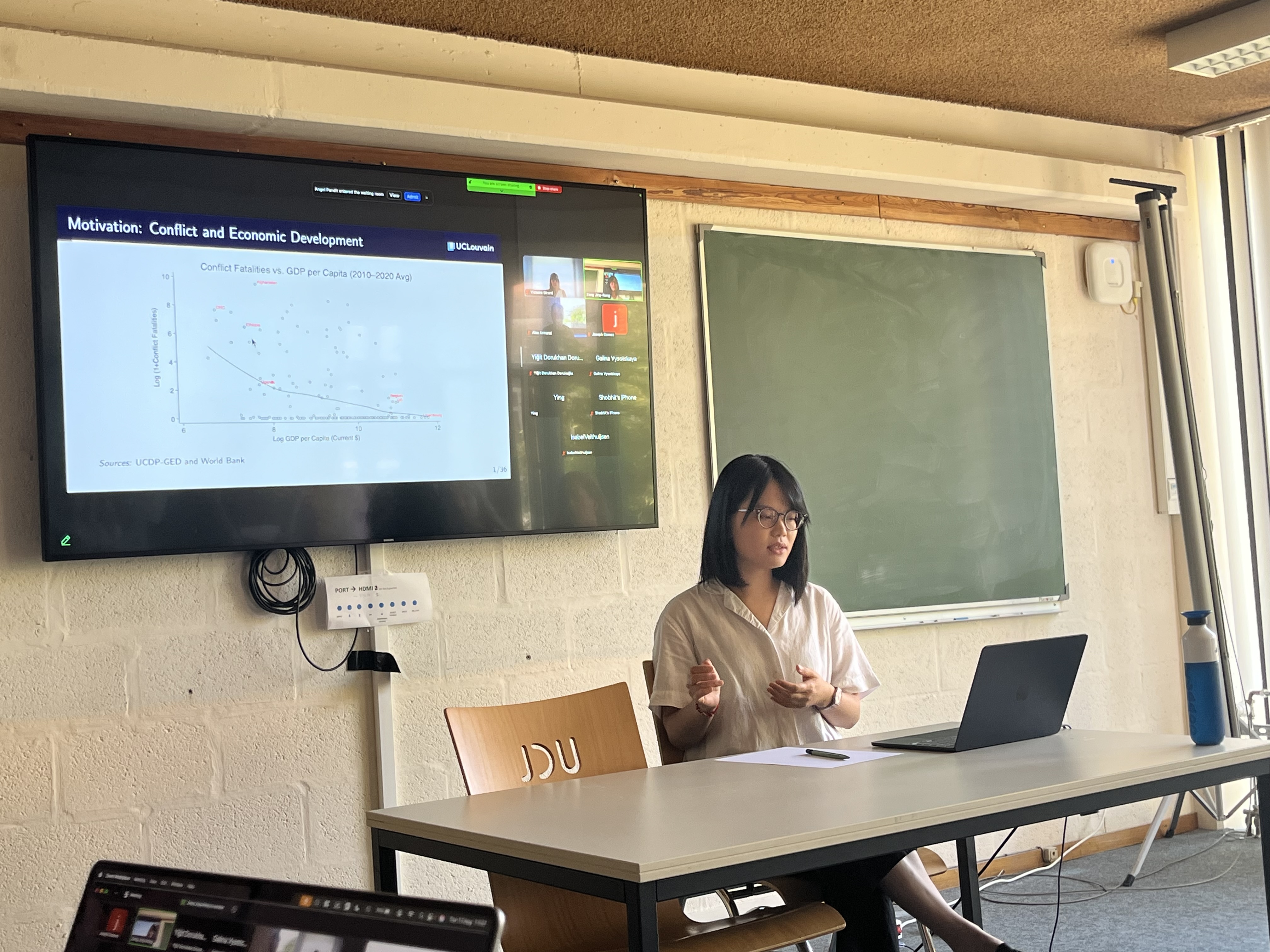
Understanding what research really means
Beyond technical skills, Jing-Rong emphasizes that a PhD is fundamentally about learning how to think and operate as a researcher.
Research, she explains, goes far beyond reading papers and running analyses. It also involves communication, collaboration, and project management.
“The PhD helped me understand that doing research is multidimensional. You need to connect your work to broader questions, communicate it clearly, and navigate institutional constraints such as funding.”
One of her key takeaways is learning to accept uncertainty while building confidence in her own abilities, a balance that defines early academic careers.
Entering the academic job market
Like many economists, Jing-Rong transitioned to her current position through the international academic job market.
In the final year of her PhD, she followed this structured and highly competitive process, which remains the primary pathway into postdoctoral and academic positions in economics.
A postdoc: continuity with greater autonomy
Today, as a Postdoctoral Fellow at the Paris School of Economics, Jing-Rong continues to focus on research, but with increased independence.
Her daily work combines individual research and collaborative projects, often in close interaction with colleagues and her postdoctoral supervisor.
The skills developed during her PhD remain central to her work:
- identifying relevant research questions
- conducting rigorous analysis
- communicating findings effectively
- collaborating across institutions
“A PhD in economics gives you a highly transferable skill set that is valuable not only in academia, but also in policy institutions and beyond.”
Advice to those considering a PhD
For prospective PhD candidates, Jing-Rong encourages careful reflection before making the decision.
Key questions to consider include:
- How many years are you willing to commit?
- What are your funding conditions?
- What are your career expectations after the PhD?
She also highlights the increasing competitiveness of the academic job market, while stressing the broader value of PhD training.
“If your expectations, funding, and personal circumstances are aligned, then a PhD is absolutely worth pursuing. It is a unique opportunity to explore a topic in depth.”
Would she do it again?
Without hesitation.
“Even though the experience was different from what I had imagined at 20, it turned out to be extremely rewarding.”
She particularly values the international exposure she gained during her time at LIDAM and across Europe, an experience that continues to shape her academic trajectory.
At a glance
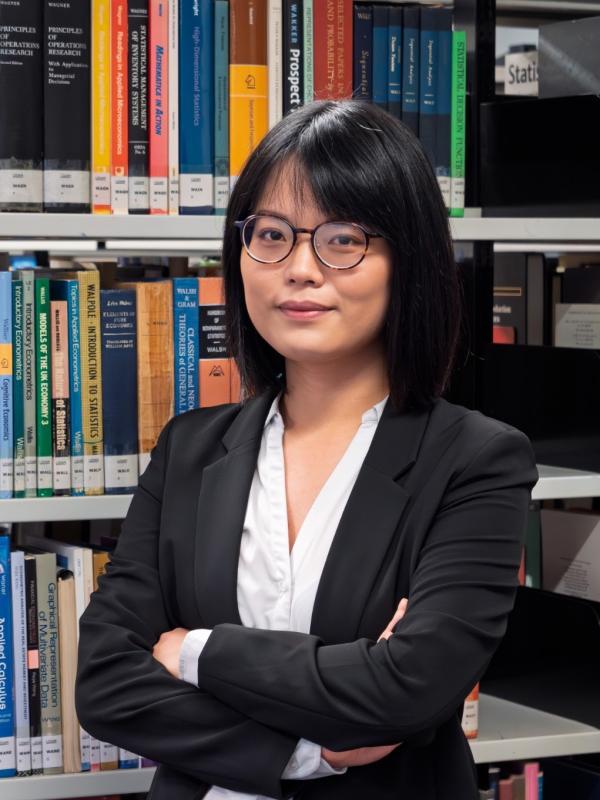
Jing-Rong Zeng
Postdoctoral Fellow, Paris School of Economics
Jing-Rong Zeng’s academic path spans multiple countries. She completed her undergraduate studies in Taipei, followed by a master’s degree in Barcelona and a research master’s in Tilburg. She then pursued her PhD at LIDAM (UCLouvain) under the supervision of Professor Joseph Gomes. She is now a postdoctoral fellow at the Paris School of Economics, specializing in development economics and political economy.