

From academic research to European policymaking: the journey of Luis Herrera
ires |
Between macroeconomic modelling, applied research, and international institutions, Luis Herrera has built a career at the intersection of academia and public policy. A graduate of UCLouvain, he is now a Senior Economist at the Financial Stability Department of the Banco de España, after previous experiences at the European Central Bank and the International Monetary Fund. Looking back on the years that shaped his trajectory, he describes a demanding PhD journey, carried out between the pandemic and major European institutions, that taught him how to turn broad economic questions into concrete tools for policymaking.
At first, nothing seemed to predestine Luis Herrera for a PhD. When he began his undergraduate studies in Economics, academic research was not even on his radar. It was only during his bachelor’s thesis, focused on public debt sustainability using a general equilibrium model, that his perspective on economics began to change. Beyond the theories and the numbers, he discovered a deeper interest in understanding the mechanisms shaping economic policy.
“This project sparked my curiosity, both about macroeconomics itself and about the quantitative tools needed to study these questions rigorously.”
Encouraged by his professors, he then joined the Research Focus Master’s in Economics at UCLouvain, a demanding programme designed as a gateway to research. As the programme progressed, one thing became increasingly clear to him: he did not want to stop there.
“By the end of the master’s, I didn’t feel ‘done’. On the contrary, I was even more motivated to keep learning and to apply these techniques to relevant economic questions.”
The academic environment itself also played a key role in his decision to continue at LIDAM. He particularly highlights the flexibility offered by UCLouvain, including the opportunity to take courses at other Belgian universities, as well as the quality of the academic supervision.
A PhD shaped by uncertainty and international opportunities
Like many doctoral researchers of his generation, Luis Herrera began his PhD during the Covid-19 pandemic. The first months were marked by isolation, remote work, and the difficulty of maintaining a stable research rhythm.
“At the beginning, the hardest aspect wasn’t only working remotely, but also losing the routines and the usual academic environment.”
Over time, however, a new balance emerged. Regular online meetings with his supervisors helped him stay connected to his research and continue progressing steadily. Looking back, he sees this period as highly formative, particularly because it taught him how to work independently while maintaining close collaboration with his supervisors.
Yet the defining moments of his PhD were undoubtedly his experiences within major international institutions. During his doctorate, he completed internships at the European Central Bank and later at the International Monetary Fund. These experiences reinforced his desire to work on research directly connected to real-world policy challenges.
“These experiences strengthened my ability to connect academic research with policy-relevant questions.”
After his first internship, he returned to the ECB for the final two years of his dissertation, immersing himself in the world of European macroprudential policy discussions. He credits the flexibility and support of his supervisors at UCLouvain for making this possible.
“A PhD taught me how to turn complex economic questions into research that can inform policymaking.”
When research directly informs public policy
Today, as a Senior Economist at the Financial Stability Department of the Banco de España, Luis Herrera works at the intersection of research and policymaking. His daily work combines macroeconomic modelling, real-time economic monitoring, and research production directly relevant for policy discussions.
“A large part of my work consists of translating economic questions into model-based exercises, running scenarios, and interpreting what the mechanisms imply for policy trade-offs.”
His PhD remains central to his professional practice. Beyond the technical expertise it provided, he emphasises the intellectual reflexes developed during those years: structuring a question, identifying key assumptions, managing uncertainty, and communicating complex results clearly.
“The PhD gave me a way of thinking. It taught me how to take a broad policy issue and turn it into a precise research question.”
That analytical mindset remains one of the most valuable legacies of his doctoral journey.
“You need to enjoy the process, not only the outcome.”
For students hesitating about starting a PhD, Luis Herrera’s advice is to reflect carefully on what truly motivates them. In his view, a doctorate is a unique intellectual experience, but also a demanding one, shaped by uncertainty and perseverance.
“A PhD can be incredibly rewarding, both intellectually and personally. But you need to enjoy the process itself, not only the idea of obtaining the degree at the end.”
Looking back today, he says he would make the same choice again without hesitation.
“There are always small things you might do differently once you’ve gone through the process. But when it comes to the important part, yes, I would absolutely choose the same path again.”
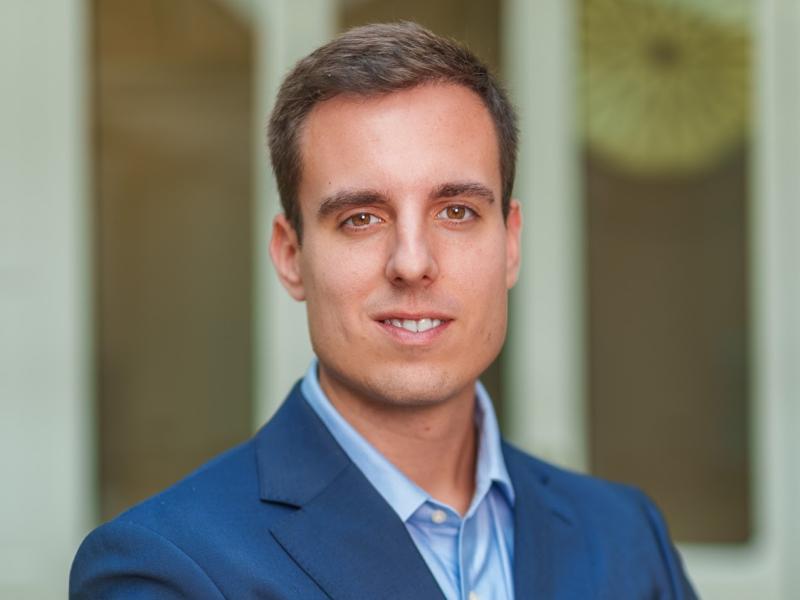
Luis Herrera is a Senior Economist at the Financial Stability Department of the Banco de España. Before joining the institution, he worked at the European Central Bank and at the International Monetary Fund. He completed his PhD at LIDAM UCLouvain after graduating from the Research Focus Master’s in Economics at UCLouvain.