

News
2025-04-18
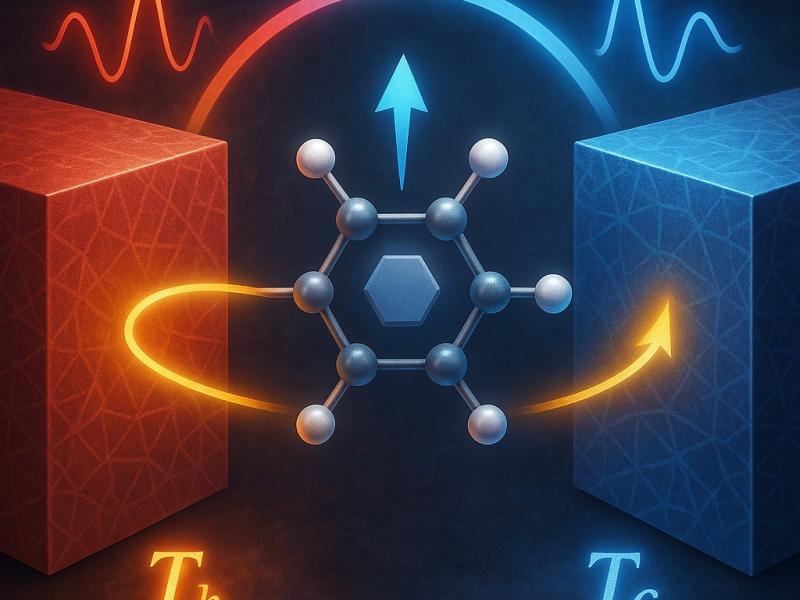
Enhancing thermoelectric output in a molecular heat engine utilizing Yu-Shiba-Rusinov bound states
Particle exchange heat engines are a novel class of cyclic heat engines that are all-electrical, contain no moving parts and can therefore be scaled down to nanometer size. At the center of their operation is the manipulation of a particle flow between a hot and a cold reservoir through energy filtering mechanisms, where their efficiency depends primarily on the sharpness of the energy filter. In this study, we investigate the efficiency enhancement of such engines by utilizing ultra-sharp transmission resonances formed by magnetic impurities interacting with superconductors, known as Yu-Shiba-Rusinov bound states. To this end, we couple a neutral and stable diradical molecule to superconducting break-junction electrodes, and study its thermoelectric properties at ultra-low temperatures. By driving the molecular heat engine through a phase transition from a Kondo state into the Yu-Shiba-Rusinov regime, we observe a five fold increase in the thermoelectric power factor. This observation could pave the way for practical applications such as cryogenic waste heat recovery and efficient spot-cooling for future quantum computing architectures.
Read article

2025-04-15
Outcompeting Thermodynamics: Ion-Pairing and Coulombic Interactions to Trigger Perfluoroacetate Intra-Ionic Photooxidation for Perfluoroalkylation Reactions
Trifluoromethylation is a key transformation in drug and agrochemical synthesis, yet current reagents often suffer from high cost, low atom economy, and low scalability. [Discover more...]
Read article

2025-03-25
Two Birds, One Stone: Microsecond Dark Excited-State Lifetime and Large Cage Escape Yield Afforded by an Iron−Anthracene Molecular Dyad
Iron photosensitizers represent a holy grail in photochemistry, but their widespread implementation is limited by their short excited-state lifetimes and poor cage escape yields.
Read article

2025-03-10
High-Performance Ionogels from Dynamic Polyrotaxane-Based Networks
The swelling of a polymer matrix by ionic liquids and additional lithium salts may lead to the
formation of ionogel electrolytes. However, the introduction of additional ions usually results in a decreased lithium-ion transference number, because of the trapping of the lithium ions in clusters and polymer-ion complexes. [Discover more...]
Read article

2025-01-13
Neuromorphic weighted sums with magnetic skyrmions
Integrating magnetic skyrmions into neuromorphic computing could help improve hardware efficiency and computational power. However, developing a scalable implementation of the weighted sum of neuron signals - a core operation in neural networks - has remained a challenge.
[Discover more...]
Read article