

Recognise and avoid predatory practices
biul |
What are predatory practices?
The world of scientific publishing is currently facing a proliferation of increasingly sophisticated fraudulent practices, the primary goal of which is to make money (through publication fees, the sale of “services,” etc.), There has been discussion of predatory journals that aim to collect publication fees by publishing articles while providing minimal or even nonexistent editorial and peer-review services. To attract submissions, these journals may employ various tactics, including:
- promoting fake impact factors
- cloning existing journals by creating websites that mimic reputable journals
- pirating legitimate articles, republishing them without consent under a new DOI to create a false publication history
- changing the dates of already published articles to artificially inflate their archives
- impersonating recognized researchers, for example by naming them as editorial board members without their knowledge
- the promise of papid publication
The risk, of course, is to undermines scientific integrity given the lack of quality control over what they publish, but it also jeopardizes your reputation as a researcher or that of your institution.
As the landscape continues to evolve, new practices are emerging today, such as “publication mills” that sell services to researchers and exploit the “publish or perish” situation
- Paper mills: Companies sell fraudulent scientific articles (containing fabricated data, plagiarism, or AI-generated content) to researchers in order to artificially inflate their publication counts. These articles are readily accepted by predatory journals, which have lax peer-review standards. Some paper mills go even further by directly bribing editors-in-chief or placing their own reviewers on editorial boards, as described by Frederik Joelving in *Science* (2024).
- Review mills: Fake reviewers write low-quality reports, slipping in biased citation recommendations to benefit researchers who have paid for this “service.”
- Citation mills: Organizations sell and manipulate citations to artificially inflate the impact of certain researchers, relying on paper mills and review mills to insert them into the traditional publication pipeline. An example of a citation mill is the insertion of hidden references into article metadata, which silently inflate citation counts.
How to avoid them ?
It exist ready-made lists of predatory publishers or journals, but as these practices are constantly evolving, it is preferable to use alerting criteria, online tools and above all to combine all this information to make the right decision (have a spectral approach).
Here are a few tools/criteria to check when in doubt:
Consult lists of criteria or tools to be taken into account and which can alert you to certain practices:
Consult white lists:
- Is the journal recorded on the portail ISSN (International Standard Serial Number Portal)
- Is it findable on known databases : Web of science, Scopus, PubMed
- MIAR (Information Matrix for the analysis of Journals,
- DOAJ (Directory of Open Access Journals),
- COPE (Commitee on Publication Ethics),
- OASPA (Open Access Scholarly Publishing Association)
Consult blacks lists:
- Cabells
- Beall's list : pay attention : it's not updated by Bells himself, we don't know who's behind it !
Ask your peers if they know the journal of members of it's edition comitee
Consult the website
And pay attention to anything that might be suspicious : a name too close to one known journal, a suspicious email adress, the lack of information contact, the mention of an Impact factor (even though the journal is not recorded elsewhere) suspicious images, etc.
To conclude : confront the sources, don't see in black or white, adopt a spectral approach to identify predatory behaviours.
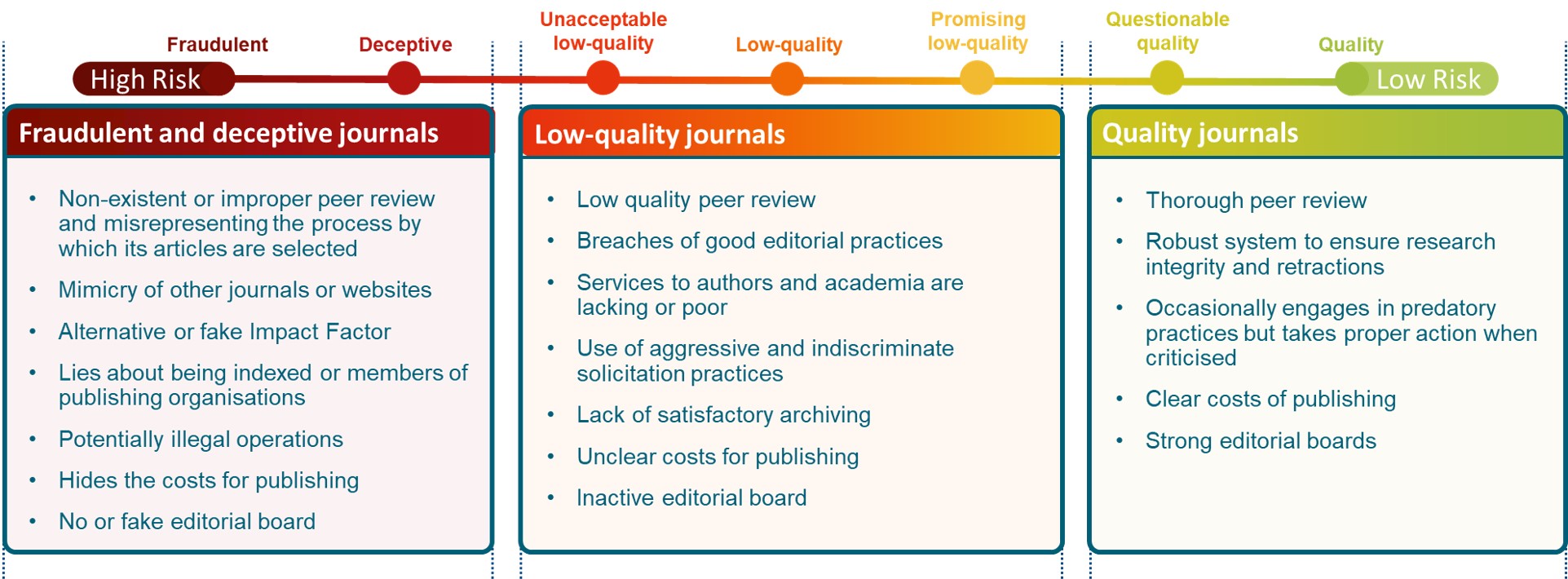
Adapted from The Interacademy Partnership (IAP 2022). Combatting predatory Academic Journals and Conferences https://www.interacademies.org/publication/predatory-practices-report-English
Sources :
- Siler K, Vincent-Lamarre P, Sugimoto CR, Larivière V. Predatory publishers’ latest scam: bootlegged and rebranded papers. Nature. oct 2021;598(7882):563‑5. doi:10.1038/d41586-021-02906-8
- Joelving F. Paper trail. Sci News. 18 janv 2024. doi:10.1126/science.zrjehzt
- Hanson MA, Barreiro PG, Crosetto P, Brockington D. The strain on scientific publishing. Quant Sci Stud. 1 nov 2024;5(4):823‑43. doi:10.1162/qss_a_00327
- Ioannidis JPA, Pezzullo AM, Boccia S. The Rapid Growth of Mega-Journals: Threats and Opportunities. JAMA. 18 avr 2023;329(15):1253‑4. doi:10.1001/jama.2023.3212
- https://openscience.pasteur.fr/2026/06/12/les-differentes-methodes-de-predation-dans-ledition-scientifique/