

Chromosome repair passed down from generation to generation
libst | Louvain-la-Neuve
Original article from UCLouvain: Une réparation des chromosomes transmise de génération en génération
Researchers at ULB and UCLouvain have uncovered an exceptional DNA repair strategy in bdelloid rotifers, tiny animals capable of surviving radiation doses that would be lethal to humans. This mechanism, named “BIHER”, provides new insights into the conditions that enable life to adapt to extreme environments.
DNA repair mechanisms are essential for maintaining the integrity of our genome. When they malfunction, they can cause disease or contribute to the development of cancer. Nature, however, offers remarkable examples of organisms that have evolved exceptional repair capabilities. Bdelloid rotifers are one such example.
These microscopic animals can survive extreme conditions, including complete desiccation and doses of ionising radiation exceeding 500 grays, more than 100 times the dose that is lethal to humans. At such levels, their chromosomes are shattered into dozens or even hundreds of pieces. How, then, can their genome be repaired and passed on to the next generation?
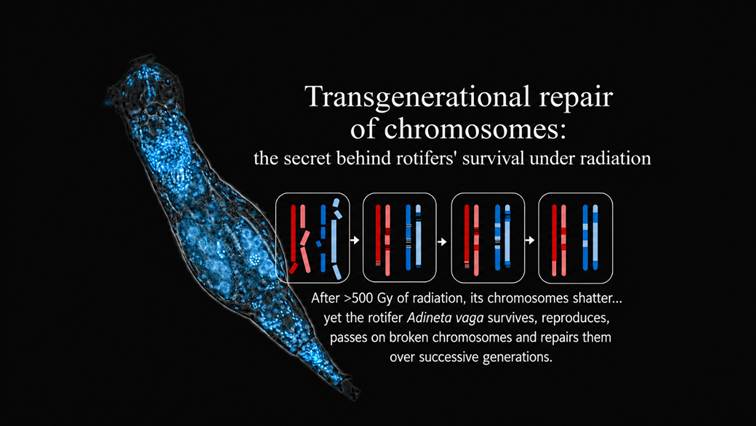
The study, whose first author is Antoine Houtain (UNamur), is published in the journal Science Advances by the teams of Karine Van Doninck (ULB) and Bernard Hallet (UCLouvain). It reveals a previously unknown repair strategy. The researchers show that, in the rotifer Adineta vaga, fragmented chromosomes are not necessarily repaired all at once. Some fragments can be retained and passed down through successive generations, then gradually reconstructed using intact fragments from the homologous chromosome as templates to copy the missing regions. The authors propose calling this new mechanism “BIHER”, short for “break-induced homologous extension repair”.
This strategy, which enables a fragmented genome to be gradually reconstructed over several generations, represents a major advance in our understanding of the extraordinary resilience of bdelloid rotifers. Beyond these organisms, the discovery shows that DNA repair can rely on mechanisms that are far more flexible and unconventional than previously thought. In the longer term, it could help improve our understanding of the consequences of genome repair defects involved in certain human diseases, including cancer.
The article on BIHER in Adineta vaga, published in Science Advances, is the third in a series of articles in the journal (Simion et al., 2021; Terwagne et al., 2022; and Houtain et al., 2026) resulting from the close and fruitful collaboration between the two teams led by Karine Van Doninck (ULB) and Bernard Hallet (UCLouvain).
For more than ten years, by combining their expertise in evolutionary and molecular biology, the researchers have gradually solved several of the major mysteries surrounding the bdelloid rotifer model species Adineta vaga. These include its asexual reproduction in the absence of males and its remarkable ability to survive both complete desiccation and exceptionally high doses of ionising radiation.
Taken together, these three studies illustrate the strength of scientific collaboration built on complementary expertise. They also show how support from several national and European funding programmes has enabled the researchers to gradually decipher the mechanisms that allow bdelloid rotifers to preserve and transmit their genome under the particularly demanding environmental conditions they encounter.
Scientific contacts: Karine Van Doninck, Molecular Biology and Evolution, ULB: karine.van.doninck@ulb.be | Bernard Hallet, Louvain Institute of Biomolecular Science and Technology, UCLouvain: bernard.hallet@uclouvain.be
Article reference: Antoine Houtain, Marc Lliros Dupré, Boris Hespeels, Emilien Nicolas, Paul Simion, Julie Virgo, Anne-Catherine Heuskin, Thomas Lenormand, Bernard Hallet, Karine Van Doninck, “Transgenerational chromosome repair in the asexual bdelloid rotifer Adineta vaga”, Science Advances.
Research funders: This research was conducted with support from the ARC, the FNRS, the European Research Council (ERC), UCLouvain’s FSR and the ULB Foundation.